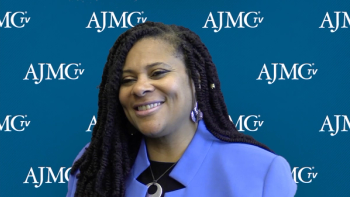
Melissa L. Johnson, MD, associate director for lung cancer research at Sarah Cannon Research Institute and partner in Tennessee Oncology, speaks on changes necessitated by the coronavirus disease 2019 (COVID-19) pandemic and connecting virtually.

Melissa L. Johnson, MD, associate director for lung cancer research at Sarah Cannon Research Institute and partner in Tennessee Oncology, speaks on changes necessitated by the coronavirus disease 2019 (COVID-19) pandemic and connecting virtually.

Obesity is common in the general population and research has shown it can increase the risk of multiple sclerosis (MS), as well as increase diagnostic delays, explained Ruth Ann Marrie, MD, PhD, director of the Multiple Sclerosis Clinic at the University of Manitoba.

Nurses often get involved with patients with multiple sclerosis (MS) before their diagnosis and then work to educate them on the disease and its care, said Amy Perrin Ross, APN, MSN, CNRN, MSCN, Neuroscience Program Coordinator at Loyola University Medical Center.

It is well known that women are disproportionately affected by multiple sclerosis (MS), but there remains a lack of understanding regarding gender differences in response to treatments for MS, said Riley Bove, MD, assistant professor of neurology at the UCSF Weill Institute for Neurosciences.

Do patients with multiple sclerosis who have been on disease-modifying therapies (DMTs) for decades need to keep taking them? John Corboy, MD, professor of neurology, University of Colorado Denver, School of Medicine, and co-director of the Rocky Mountain MS Center at Anschutz Medical Campus, explains what is known about this area.

Many patients with secondary progressive multiple sclerosis (SPMS) are actually being misclassified and treated as if they have relapsing-remitting MS (RRMS), which can have an impact on research, treatment, and health care planning, said Jan Hillert, MD, PhD, professor and senior physician at Karolinska Institutet.

There is a push to diagnose multiple sclerosis (MS) earlier, which can lead to misdiagnosis if the diagnostic criteria aren’t used properly, explained Patricia K. Coyle, MD, director of the MS Comprehensive Care Center and professor of neurology at Stony Brook University Neurosciences Institute.

A vaccine for coronavirus disease 2019 (COVID-19) is aspirationally possible by the end of the year and the beginning of 2021, noted Anthony S. Fauci, MD, director of the National Institute of Allergy and Infectious Diseases.

Melissa L. Johnson, MD, associate director for lung cancer research at Sarah Cannon Research Institute and partner in Tennessee Oncology, discusses the potential of tiragolumab/atezolizumab for metastatic non–small cell lung cancer (NSCLC).

Providers need to focus on detecting and treating cardiovascular complications in at-risk patients, and not get lost in the fact they have COVID-19, said Manan Pareek, MD, PhD, FAHA, FESC, an internal medicine hospital resident at the Yale University School of Medicine.

In the past 30 years, we've never seen a heart failure drug that has had such a beneficial effect on the kidneys, said Milton Packer, MD, a distinguished scholar in cardiovascular science at Baylor University Medical Center in Dallas, and chair of the department of clinical sciences at the University of Texas Southwestern Medical School.

If you change the narrative and package SGLT-2 inhibitors as a form of cardiovascular risk modulation, cardiologists may be more likely to get involved in diabetes management, said Javed Butler, MD, MPH, MBA, chairman for the Department of Medicine at the University of Mississippi.

During the surge of the pandemic in the Northeast, we saw about a 40% reduction in cardiovascular admissions, while there was a higher rate of mortality among patients who came in, said Deepak L. Bhatt, MD, MPH, of Brigham and Women’s Hospital Heart & Vascular Center and Harvard Medical School.

It is imperative individuals with cardiovascular diseases remain active despite COVID-19 lockdowns, said Antonio Pelliccia, MD, senior consultant and chief of cardiology at the Institute of Sports Medicine and Science, of the Italian National Olympic Committee.

Melissa L. Johnson, MD, associate director for lung cancer research at Sarah Cannon Research Institute and partner in Tennessee Oncology, discussed the biggest gains in the lung cancer space that have contributed to improved survival for patients.

It's a great time to be a doctor treating patients with heart failure, given the development of 2 fantastic new treatments within the space of 5 years, said John McMurray, MD, FRCP, FESC, professor of medical cardiology in the Institute of Cardiovascular and Medical Sciences at the University of Glasgow.

The new guidelines can help cardiologists better advise patients with CVD on physical activity, said Antonio Pelliccia, MD, senior consultant and chief of cardiology at the Institute of Sports Medicine and Science, of the Italian National Olympic Committee.

It's interesting that we saw such a clear U-shaped mortality curve for serum bicarbonate levels in a patient population where we usually don't think about measuring bicarbonate, said Manan Pareek, MD, PhD, FAHA, FESC, an internal medicine hospital resident at the Yale University School of Medicine.

Having 2 trials that both show benefits of SGLT2 inhibitors in heart failure hospitalizations can only encourage the use of these drugs, said John McMurray, MD, FRCP, FESC, professor of medical cardiology in the Institute of Cardiovascular and Medical Sciences at the University of Glasgow.

Advances in imaging have made assessment of atherosclerosis non-invasive, while the EVAPORATE trial demonstrates how cardiac CT can assist in looking at a host of different therapies, said Matthew Budoff, MD, professor of medicine at the David Geffen School of Medicine at UCLA and investigator at The Lundquist Institute.

There is a certain element of antiscience sentiment in the United States and Europe that Anthony Fauci, MD, director of the National Institute of Allergy and Infectious Diseases, finds troubling.

It's very important to take the EMPEROR-Reduced and DAPA-HF trials together as being complementary, said Milton Packer, MD, of Baylor University Medical Center in Dallas and University of Texas Southwestern Medical School.

In this most recent analysis of REDUCE-IT, results show a consistent benefit favoring icosapent ethyl versus placebo irrespective of the actual statin type, said Deepak L. Bhatt, MD, MPH, of Brigham and Women’s Hospital Heart & Vascular Center and Harvard Medical School.

Early rhythm control was associated with a marked reduction in cardiovascular deaths among at-risk stroke patients, said Paulus Kirchhof, MD, director of the department of cardiology at the University Heart and Vascular Center UKE Hamburg, and professor of cardiovascular medicine at the Institute of Cardiovascular Sciences at the University of Birmingham.

When results from the EMPA-REG OUTCOME trial came out, nobody was expecting empagliflozin to have a particularly robust benefit on heart failure and several questions were raised as a result, said Javed Butler, MD, MPH, MBA, chairman for the Department of Medicine at the University of Mississippi.

Through EVAPORATE, we've been able to show at 18 months that patients taking icosapent ethyl (Vascepa) have less plaque and that there is some atherosclerosis regression, marking mechanisms of benefit for these patients, said Matthew Budoff, MD, professor of medicine at the David Geffen School of Medicine at UCLA and investigator at The Lundquist Institute.

Anthony Fauci, MD, director of the National Institute of Allergy and Infectious Diseases, spoke recently with The American Journal of Managed Care®. During the interview, we asked about health burdens that disproportionately affect Black and other multiracial US communities.

By increasing access and awareness of mental health services, employers can assist in addressing concerns precipitated by pandemic and racial injustice to curb potentially severe and persistent mental illness, said Joe Grasso, PhD, clinical director of partnerships at Lyra Health.

The impact of impaired sleep, which is more frequent among adolescents, was associated with a greater risk of asthma and allergies among this age group, but association does not equal causation. As a result, these associations warrant greater investigation, as well as the potential effects of social determinants of health such as race and socioeconomic status, said Lakiea Wright, MD, practicing physician at Brigham and Women's Hospital in Boston and the medical director at Thermo Fisher Scientific.

Whether you fit into the older or younger demographic, staying up to date on eye care is key as growing risks of cataracts, glaucoma, diabetic retinopathy, and macular degeneration are leading causes of blindness. Moreover, reducing the structural barriers to eye care, which disproportionately affect blacks and Afro Latinos, can assist in advancing the availability of eye health nationwide, said Daniel Laroche, MD, director of Glaucoma Services and president of Advanced Eye Care of New York.

259 Prospect Plains Rd, Bldg H
Cranbury, NJ 08512
© 2025 MJH Life Sciences®
All rights reserved.