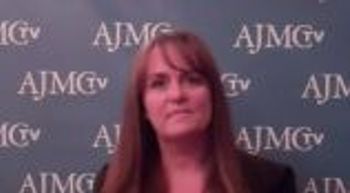
Thomas Stinchcombe, MD, assistant professor of clinical research, UNC Lineberg Comprehensive Cancer Center, discusses the treatment of patients with non-small cell lung cancer (NSCLC).

Thomas Stinchcombe, MD, assistant professor of clinical research, UNC Lineberg Comprehensive Cancer Center, discusses the treatment of patients with non-small cell lung cancer (NSCLC).

New revenue models in healthcare are causing innovative payer-provider partnerships. John Harris, MBA, spoke about some of these new partnerships and how all stakeholders must consider each other's mindsets when choosing a model that works for them.

Richard Stefanacci, DO, Associate Professor, Health Policy & Public Health, University of the Sciences, says there are 2 cost concerns associated with neurodegenerative diseases.

Technology continues to advance at such an incredible pace that it can be hard for many industries to keep up with the ways in which new systems and processes can help them be more effective. In this morning's session, Your Next Provider Will Be an Avatar, presenter Thomas Morrow, MD, explained why it's necessary for the healthcare industry to not only keep pace with technological innovations, but also to integrate these technologies into several aspects of care.

Dr. Jacque Sokolov, MD, Chairman & CEO, SSB Solutions, Inc, says that value-based products and the revenue flow associated with them is evolving on the commercial side as well as the Medicare and Medicaid sides.

Implementing an accountable care organization model can be a rigorous process. With so many stakeholders, it is necessary for all those involved in the process to collaborate and communicate effectively throughout the transition. For these reasons, it is essential for any organization to have the proper leadership in place to ensure a smooth implementation.

Check out photos from this year's conference in Atlanta, GA, which took place from October 20-25. The meeting was held at the Georgia World Congress Center, which sits between CNN headquarters and the Georgia Dome.

Robert De Marco, MD, FCCP, Intensivist, Orlando Health, Dr. Phillips Hospital, says that a concern for reimbursement in the ICU is that many private physicians are becoming hospital employed. He says that convincing the hospital they need full-time critical care coverage is a difficult task even though it saves cost and cuts down length of stay and mortalities.

Brian Carlin, MD, FCCP, Allegheny General Hospital, states that there are many challenges in providing pulmonary rehabilitation to patients with chronic lung diseases.

Although there has been a concentrated focus on pulmonary vascular diseases at this year's CHEST conference, there have also been a number of studies released that pertain to cardiovascular events, such as congestive heart failure, atrial fibrillation, and chronic obstructive pulmonary disease. Here are some of the highlights in these areas.

As one might expect, lung cancer is one of the major focuses at each CHEST conference. The following are highlights from this year's recently released abstracts and late-breaking studies.

Although there have been a wide variety of disease states covered at this year's CHEST conference, much of the focus has been on those under the umbrella of pulmonary vascular disease, such as pulmonary arterial hypertension and deep vein thrombosis. Here are some of the new study highlights related to pulmonary vascular disease.

Jun Chiong, MD, MPH, FACC, FCCP, Associate Professor of Medicine, Loma Linda University Medical Center, states the US healthcare system does not utilize a team-based approach.

Robert Frantz, MD, FACC, Director, Pulmonary Hypertension Clinic, Mayo Clinic, says that the issue of cost is an important factor in treating patients with pulmonary arterial hypertension.

The following are highlights of abstracts that focus on readmission rates, an increasingly important subject for hospitals that are subject to evolving rules and regulations as they relate to reimbursement.

Craig Lilly, MD, Professor of Medicine, Anesthesiology and Surgery, Director, UMass Memorial eICU Program, says that technologies must be integrated as well as embraced by the workforce.

The CHEST 2012 meeting features a number of newly published studies for a wide variety of disease states ranging from tuberculosis to lung disease. The following are highlights of hypertension abstracts.

Edward Zawada, MD, MACP, Vice President of Scientific Affairs, Medical Director, Intensivist Program, Medical Director, eICU Program, Avera Medical Group Nephrology, says that the Tele-Intensive Care Program provides the skill set required to care for critically ill patients.

Robert Frantz, MD, FACC, Director, Pulmonary Hypertension Clinic, Mayo Clinic, discusses the rate of bloodstream infections in patients with pulmonary arterial hypertension treated with Veletri. Dr Franz also talks about the PROSPECT registry analysis.

Cost has been front of mind for many researchers that have released new study data at CHEST 2012. Here are some of the highlights from the new research.

Brian Carlin, MD, FCCP, Allegheny General Hospital, discusses the challenges in reducing 30-day readmission rates, specifically as they apply to congestive heart failure, pneumonia, and COPD. The biggest challenge is setting up a coordinated team care effort, says Dr Carlin.

Hundreds of new abstracts were published for CHEST 2012. Here are some of the highlights around the topic of quality of life as they relate to various disease states.

In this video, Aaron McKethan, PhD, Vice President, Strategy and Business Development, RxAnte, talks about new strategies to improve patient medication adherence.

There exists a need for a standard of care to ensure that each patient's medications are appropriate, effective, safe, and able to be taken as intended. Medication therapy management (MTM) is a professional service that can help meet this need. Although the practice of providing comprehensive MTM services by phone has many positive attributes, there are many challenges associated with this type of intervention.

Brian Sweet, RPh, MBA, Executive Director, Health Care Alliances, AstraZeneca Pharmaceuticals, talks about the progress that has been made to-date in integrating clinical data elements with administrative claims data.

Medication assessments directly impact the way a drug is covered, and drugs with better quality data with a higher level of certainty are more favorably covered. Accurately assessing the evidence for new medications will help payers summarize a drug's benefit-to-risk ratio.

In this video, Aimee Tharaldson, PharmD, Senior Clinical Consultant, Emerging Therapeutics Express Scripts, Inc, talks about the impact that biosimilar medications could potentially have on the specialty pharmacy market.

Edith Rosato, RPh, IOM, the chief executive officer of the Academy of Managed Care Pharmacy, recently shared the organization's Top 5 strategic priorities for the coming year.

In this video, Feng Zeng, PhD, Senior Health Economist, MedImpact, discusses how the implementation of copayment reduction in the gap in 2011 influenced adherence measures for oral diabetes medications.

The role of the pharmacist in the care of patients with cancer is evolving. Pharmacists can help optimize treatment outcomes for each patient through use of patient-specific and disease-specific strategies.

259 Prospect Plains Rd, Bldg H
Cranbury, NJ 08512
© 2025 MJH Life Sciences®
All rights reserved.