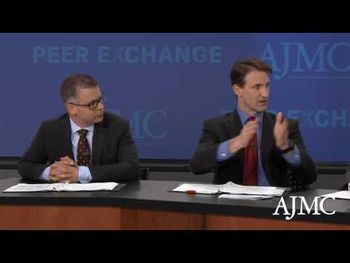



The panelists discuss clinicians and their perspectives on financial constraints in treatment of NSCLC.

The panelists discuss clinicians and their perspectives on financial constraints in treatment of NSCLC.

Dr Peskin begins by stating, costs are exceedingly consequential. Cancer care and treatment is occupying, and with demographics being what they are, increasingly larger relative total cost of care across the US, including various national organizations.

Dr Peskin discusses programs such as Choosing Wisely and how providers must be mindful of high value, cost-conscious, cost-aware care.

Narrow networks are here to stay. Some of the nation's top payers and providers are leading the way.

Insurance companies aren't crazy about their share of the health law's taxes, but mostly they've complained to politicians and regulators.

Cancer drug prices have doubled in the past decade, from an average of $5,000 per month to more than $10,000.

To keep premium prices down for individuals and small businesses buying coverage through new online marketplaces, insurers have created smaller networks of hospitals. But consumers and policy experts have wondered, just how small?

Access is an important component of the Triple Aim (cost, quality, access), and it has also been stressed as a significant factor in health reform initiatives. As the influx of uninsured increasingly seeks care, and if the number of providers available to provide primary care decreases as projected, achieving access to quality and cost-effective care may become more problematic.

Enrollment in new Obamacare exchanges may be lagging, but experts said Thursday that the health law's massive expansion of Medicaid could place more than 8 million low-income people in the program before the first year is up.

There is no question that the number of accountable care organizations in Medicare and total cost of care contracts in the private sector is growing, along with the amount of care provided under these contracts.

Competition over healthcare prices and quality is coming. Transparency and the radical redesign of health insurance benefits will be its handmaiden. Companies such as General Electric are leading the way.

Reference prices, a health benefit strategy that requires patients to pay costs above a set price, may save employers and patients money, but their potential may be limited-perhaps even more so under the Patient Protection and Affordable Care Act.

The Affordable Care Act has dramatically increased the cost of buying a health insurance plan on the individual market in California, Texas, Florida, New York, Illinois, Georgia, and North Carolina, states that account for more than half of America's uninsured adults.

Reigning in costs is a key component of healthcare reform. So it is clear why it will be essential for both providers and policy makers to identify those most at risk for driving up costs.

Much of the healthcare spotlight has been squarely focused on the federal and state implementation of the Affordable Care Act (ACA). Yet, there is another fundamental shift in policy that is occurring at the private level that will change the way health insurance is offered to consumers.

Almost 80 million people with employer health plans could find their coverage canceled because they are not compliant with ObamaCare, several experts predicted.

Balancing competing goals of innovation and regulatory oversight will influence the evolution of the vendor market for certified ambulatory electronic health record products.

Another day brings another delay for the federal health law known as the Affordable Care Act.

In what is likely to be a relief to dialysis providers, the CMS decided to phase in the controversial payment cut to dialysis providers over a three- to four-year period.

The Obama administration plans to push back by a month the second-year start of enrollment in its health program to give insurers more time to adjust to growing pains in the U.S. law, a move that may stave off higher premiums before the 2014 congressional elections.

Adopting the 5 core medication management elements of meaningful use electronic medical records reduces adverse drug events and saves costs.

As Americans have begun shopping for health plans on the insurance exchanges, they are discovering that insurers are restricting their choice of doctors and hospitals in order to keep costs low, and that many of the plans exclude top-rated hospitals.

You get what you pay for: That old saw applies to most corners of American consumerism, but not to healthcare. Convincing people of that is tough.

Capping federal Medicaid spending, raising the eligibility age for Medicare, and bundling Medicare payments to healthcare providers are some of the federal spending reduction possibilities included in a report by the Congressional Budget Office released Wednesday.

Finding a health plan on the Medicare website could be troublesome for some seniors.

259 Prospect Plains Rd, Bldg H
Cranbury, NJ 08512
© 2025 MJH Life Sciences®
All rights reserved.