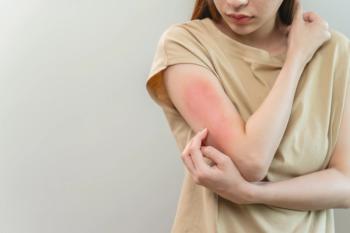
Patch testing in Malaysia finds contact dermatitis drivers in chronic hand eczema—nickel and fragrance allergy lead, while cosmetics raise polysensitization risk.
Chronic hand eczema affects roughly 5% of adults each year, exacts most of its toll at work, and is not simply atopic dermatitis of the hands.
Hands cannot be tucked under a sleeve, rested for a week, or excused from a shift. That constant exposure—mechanical, chemical, and social—helps explain why
Here are 5 things every dermatologist should know about chronic hand eczema and its growing treatment space.
CHE is diagnosed when hand eczema persists beyond 3 months or recurs at least twice within a year.1 Median duration runs 11 to 16 years, and symptoms flare rather than resolve cleanly, so patients often manage the condition across a decade or more of working life.
The multinational CHECK survey of 60,131 adults in Canada, France, Germany, Italy, Spain, and the UK put the annual prevalence of self-reported physician-diagnosed CHE—defined per European Society of Contact Dermatitis criteria—at 4.7% (95% CI, 4.6%-4.9%), significantly higher in women than in men (5.6% vs 3.8%; P < .001) and in employed vs unemployed people (5.3% vs 3.3%; P < .001).2 Prevalence peaked at 6.5% between ages 30 and 39 years.
The RWEAL retrospective chart review of 1939 adults with moderate to severe CHE, drawn from 292 physicians in 6 countries, found multiple etiological subtypes, with irritant contact dermatitis the most frequent at 40.1%, followed by
“Many patients had no atopic condition besides CHE, and no history of atopic dermatitis, indicating that CHE is not simply atopic dermatitis of the hands,” the researchers wrote. Molecular evidence points the same way: tape stripping of lesional skin from 66 adults with moderate to severe CHE found that those without comorbid atopic dermatitis skewed toward type 1 immune signaling, while those with it showed a stronger type 2 pattern.4
Distinct does not mean unrelated. A systematic review and meta-analysis found that atopic dermatitis was associated with a substantially higher lifetime prevalence of hand eczema (OR, 4.06; 95% CI, 2.72-6.06) and 1-year prevalence (OR, 4.29; 95% CI, 3.13-5.88), along with elevated lifetime risk of occupational hand eczema (OR, 2.81; 95% CI, 2.08-3.79).5
Atopic hand dermatitis is increasingly treated as its own entity within CHE, shaped by what is likely a distinct interplay of environmental triggers, genetic predisposition, and immune dysfunction.6 Identifying it means catching subtle differences from conditions that mimic CHE on the hands, such as psoriasis, tinea, and palmoplantar pustulosis—a differential complex enough that misdiagnosis itself may contribute to chronicity.1
Among 507 individuals surveyed in a US managed care organization, work time missed did not differ significantly between those with and without CHE, but impairment while working did (mean, 26.86% vs 12.68%; P < .001), as did overall work impairment (29.33% vs 6.85%; P < .001). Among 500 Dutch adults with CHE, 40.8% reported working through the condition in the past year, and 22.7% did so when they should have rested, fearing job loss.
Annual societal costs per patient across European studies ranged from €1813 to €7738, with indirect costs accounting for roughly half or more; a systematic review found up to 57% took sick leave and up to 25% left or changed jobs. In a European multicenter study, patients with hand eczema reported significantly greater clinical depression, anxiety disorder, and suicidal ideation than those with other common skin diseases.
Topical corticosteroids remained the mainstay for decades despite documented limits. In survey data from the Danish Skin Cohort, 84.8% of 724 adults reported at least 1 adverse event from using them for CHE, most commonly skin atrophy, and 76% preferred a nonsteroidal option. In a separate multicenter study of 819 patients, 12.5% were refractory to topical corticosteroid therapy altogether.
That changed on July 23, 2025, when the FDA approved d≈o; LEO Pharma) cream 20 mg/g, a topical pan–Janus kinase inhibitor, as the first US treatment indicated specifically for moderate to severe CHE in adults with an inadequate response to topical corticosteroids or for whom they are not advisable.7 Approval rested on DELTA 1 (
The completed head-to-head phase 3 DELTA FORCE trial (
For payers and clinicians, CHE warrants a work-up rather than a reflexive prescription, because patch testing, an occupational history, and subtype identification determine which of the newly widened options fits. Pinpointing the cause often takes time and detective work, and lasting relief depends on finding and avoiding a specific trigger as much as on the drug applied over it.10
References