Among 4378 Spanish registry patients, dyshidrotic eczema was less tied to occupation than other hand eczema.
Irritants, cleaning products, and mites tracked with SHE in 56,978 Dutch adults, although the exposure tool was built for occupational asthma.
For nurses, cleaners, hairdressers, and bakers, the exposure that matters most is the one no safety data sheet covers: what their hands touch all shift. Across nearly 57,000 Dutch adults, occupational contact with irritants, disinfectants, and cleaning products tracked with moderate to very severe
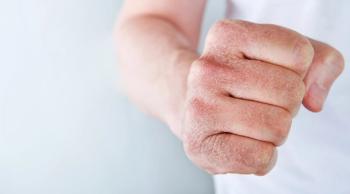
Hand eczema is multifactorial, but its most relevant exogenous risk factor is exposure to irritants and allergens, and that exposure occurs predominantly at work. Repeated contact with wet work, soaps, or disinfectants can produce irritant contact dermatitis of the hands, and fragrances, acrylates, or epoxy resins can produce allergic contact dermatitis in sensitized workers. Up to 60% of European general-population cases are considered work-related.
The disease is common enough for that fraction to matter. A meta-analysis of 66 studies covering 568,100 people put the pooled lifetime prevalence at 14.5% (95% CI, 12.6%-16.5%) and the 1-year prevalence at 9.1%, with more than a third of affected individuals reporting moderate or severe disease and occurrence 1.5 to 2 times higher in women than men.2 Research linking that burden to specific workplace agents has leaned on retrospective self-reported exposure, which invites recall and misclassification bias, and no existing job exposure matrix addresses irritants beyond wet work or allergens relevant to the hands.
A digital skin questionnaire went to 135,950 adults in the Lifelines Cohort Study in 2020, drawing a 42.5% response to the question on lifetime hand eczema.1 This cross-sectional add-on analysis included 56,978 participants, and the regression models compared 1572 people reporting moderate to very severe hand eczema at worst in the past year against 48,423 who reported never having had it. Self-reported 1-year prevalence in the full sample was 7.3%, and lifetime prevalence was 15.0%.
Occupations coded to the International Standard Classification of Occupations were linked through the Occupational Asthma-specific job exposure matrix (OasJEM), which carries expert-assigned ratings for 30 agents sorted into 8 groups, one of them—disinfectants and cleaning products—added for this analysis. Exposure was rated as none, medium, or high. The group reporting severe hand eczema was younger and contained more women, with a mean age of 49.2 vs 55.9 years, 72.9% female vs 58.3% male, and 45.2% reporting physician-diagnosed
Four of the 8 exposure groups were associated with moderate to very severe hand eczema: irritants (adjusted OR, 1.19; 95% CI, 1.06-1.33), high molecular weight sensitizers (adjusted OR, 1.20; 95% CI, 1.06-1.36), mites (adjusted OR, 1.41; 95% CI, 1.16-1.73), and disinfectants and cleaning products (adjusted OR, 1.25; 95% CI, 1.11-1.42). Low molecular weight sensitizers, highly reactive chemicals, and biocides showed no association as whole groups.
Among the individual agents reported, indoor cleaning products carried the largest association (adjusted OR, 1.31; 95% CI, 1.15-1.50), followed by bleach (adjusted OR, 1.20; 95% CI, 1.03-1.40) and latex (adjusted OR, 1.18; 95% CI, 1.03-1.36). Each additional agent a worker was exposed to was associated with incrementally higher odds (adjusted OR, 1.04; 95% CI, 1.01-1.07). High-level chemical disinfectants and organic solvents showed no association.
Associations varied by exposure level. Both medium and high exposure to irritants were associated with severe hand eczema (adjusted OR, 1.17; 95% CI, 1.02-1.33 and adjusted OR, 1.22; 95% CI, 1.05-1.43), as were both levels of exposure to the disinfectants and cleaning products group (adjusted OR, 1.22; 95% CI, 1.06-1.41 and adjusted OR, 1.32; 95% CI, 1.10-1.59). For highly reactive chemicals and biocides, only high exposure was associated (adjusted OR, 1.26; 95% CI, 1.05-1.50 and adjusted OR, 1.28; 95% CI, 1.06-1.55). The occupations the matrix flags as most exposed to disinfectants and cleaning products are nurses, domestic helpers and cleaners, and personal care workers; hairdressers, butchers, and varnishers top the irritants group; and housekeepers, gardeners, and agricultural laborers top the mites group.
The authors were direct about what the approach cannot do. The OasJEM was designed to capture agents associated with occupational asthma and does not necessarily reflect exposure through direct skin contact, the route that matters most for hand eczema, which could have produced misclassification and blurred the associations reported. Participants were coded to the 2008 occupational classification, while the matrix is built on the 1988 version, so a crosswalk between them adds a second route to misclassification. The matrix also was constructed to favor specificity over sensitivity, which would push estimates toward the null. Exposure was assigned by job title rather than measured, leaving variation between workers in one occupation invisible; hand eczema was self-reported, with no way to separate irritant from allergic contact dermatitis; the cross-sectional design cannot establish timing; and the 42.5% response rate leaves room for selection bias.
The authors also raised the possibility that the causal arrow runs the other way for 2 of the 4 positive findings. Workers exposed to irritants or allergens may adopt heightened hygiene measures and wear gloves more often, and that behavior could itself account for the associations seen with mites and high molecular weight sensitizers rather than those exposures damaging the skin directly.
“Nonetheless, the findings of the present study highlight the importance of a thorough occupational history by dermatologists and/or occupational physicians in patients with [hand eczema], taking into account a wide range of occupational irritants and contact allergens, including those traditionally associated with occupational asthma,” the authors wrote.
The practical value lands with employers, occupational health programs, and payers covering a service and health care workforce. The exposures implicated here are ordinary features of nursing, cleaning, personal care, food handling, and agricultural work, and they are modifiable through task design and product selection rather than through treatment alone. The senior author disclosed consultancies, grants, or investigator roles with several dermatology manufacturers, and the Lifelines cohort is supported by Dutch government ministries and regional public funders. Future work should collect task-based exposure data specific to hand eczema, the authors argued, rather than borrow a matrix built for another organ.
References
1. Brands MJ, Loman L, Bültmann U, Schuttelaar MLA. Challenges of using the occupational asthma-specific job exposure matrix to assess occupational exposure and hand eczema. Front Allergy. 2026;7:1838194. doi:10.3389/falgy.2026.1838194
2. Quaade AS, Simonsen AB, Halling AS, Thyssen JP, Johansen JD. Prevalence, incidence, and severity of hand eczema in the general population—a systematic review and meta-analysis. Contact Dermatitis. 2021;84(6):361-374. doi:10.1111/cod.13804