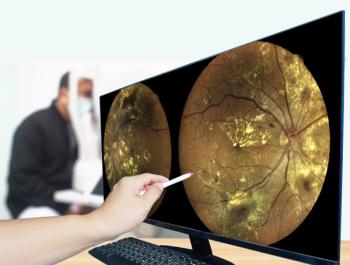
The meeting covered several topics in eye care, including how artificial intelligence (AI) can play a part in eye care.
Innovative deep proteomic profiling reveals promising results from a blood-based test for early breast cancer, showcasing high sensitivity and specificity, explains Justin Drake, PhD.
Captions were auto-generated.
Current standard mammography sensitivity can be as low as 30% for women with dense breast tissue, a group facing a 2-fold higher risk, according to new research. Furthermore, existing liquid biopsies based on nucleotide assessment achieve only 20% sensitivity for early-stage disease. The need for an alternative approach is critical.
Groundbreaking research on a novel blood-based assay for early breast cancer detection, Certitude Breast from Astrin Biosciences, is being presented at the
The study evaluated plasma from a cohort of approximately 1250 women, focusing on early-stage disease (stages 0-2), of whom approximately half were healthy women and half had been diagnosed with breast cancer, according to Justin Drake, PhD, associate professor, University of Minnesota, and chief science officer, Astrin Biosciences, in an interview with The American Journal of Managed Care®.
Overall, the deep proteomic profiling identified over 8600 total proteins. To handle this massive amount of data, an artificial intelligence (AI) machine learning classifier was trained on these features. The classifier was developed using an exponentiated gradient method and incorporated constraints across multiple sample sources to ensure the model’s generalizability.
The results from the blinded validation set are highly promising: the AI classifier demonstrated a sensitivity of 92.3% at a specificity of 92.6% in separating healthy controls from patients with breast cancer. Crucially, the test maintained high accuracy even for stage 0 and stage 1 disease. Further, sensitivity remained high (above 84%) across all stages and pathological subtypes, including over 90% sensitivity for aggressive triple-negative breast cancer. Pathway analysis confirmed the identified proteomic markers were connected to known breast cancer hallmarks, including PI3K/AKT signaling and epithelial-to-mesenchymal transition.
Reference
Horrmann A, Travadi Y, Schaap G, et al. Deep proteomics and AI Classifier for early breast cancer detection. Presented at: San Antonio Breast Cancer Symposium; December 9-12, 2025; San Antonio, Texas. Poster PD5-03.