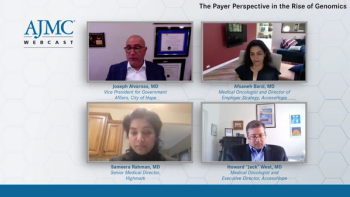
In part 3 of the Oncology Value Coalition webinar, experts from City of Hope and Highmark discussed the payer perspective in the rise of genomics.
In part 3 of the Oncology Value Coalition webinar, experts from City of Hope and Highmark discussed the payer perspective in the rise of genomics.
In part 2 of the Oncology Value Coalition webinar, experts from City of Hope and Highmark discussed how genomics have changed the cancer care landscape.

In the latest Oncology Value Coalition webinar, experts from City of Hope and Highmark discussed designing genomic testing in cancer care.
In the April Matters in Managed Care webinar, leaders from Anthem and a partner of Anthem’s Doula Pilot Program in California discuss how a health plan can take an active role in reducing disparities in maternity mortality, which has been recognized by the World Health Organization as a growing health concern in the United States.
In the April Matters in Managed Care webinar, leaders from Anthem and a partner of Anthem’s Doula Pilot Program in California discuss how a health plan can take an active role in reducing disparities in maternity mortality, which has been recognized by the World Health Organization as a growing health concern in the United States.

In the April Matters in Managed Care webinar, leaders from Anthem and a partner of Anthem’s Doula Pilot Program in California discuss how a health plan can take an active role in reducing disparities in maternity mortality, which has been recognized by the World Health Organization as a growing health concern in the United States.
In the April Matters in Managed Care webinar, leaders from Anthem and a partner of Anthem’s Doula Pilot Program in California discuss how a health plan can take an active role in reducing disparities in maternity mortality, which has been recognized by the World Health Organization as a growing health concern in the United States.
In the April Matters in Managed Care webinar, leaders from Anthem and a partner of Anthem’s Doula Pilot Program in California discuss how a health plan can take an active role in reducing disparities in maternity mortality, which has been recognized by the World Health Organization as a growing health concern in the United States.
In the April Matters in Managed Care webinar, leaders from Anthem and a partner of Anthem’s Doula Pilot Program in California discuss how a health plan can take an active role in reducing disparities in maternity mortality, which has been recognized by the World Health Organization as a growing health concern in the United States.
In the April Matters in Managed Care webinar, leaders from Anthem and a partner of Anthem’s Doula Pilot Program in California discuss how a health plan can take an active role in reducing disparities in maternity mortality, which has been recognized by the World Health Organization as a growing health concern in the United States.
In the April Matters in Managed Care webinar, leaders from Anthem and a partner of Anthem’s Doula Pilot Program in California discuss how a health plan can take an active role in reducing disparities in maternity mortality, which has been recognized by the World Health Organization as a growing health concern in the United States.
In the inaugural Oncology Value Coalition from The American Journal of Managed Care®, Kashyap Patel, MD, led a discussion with Debra Patt, MD, PhD, MBA; and Karen Winkfield, MD, PhD, exploring findings that suggest minority groups develop cancer at higher rates and experience worse outcomes than nonminority groups.

In the inaugural Oncology Value Coalition from The American Journal of Managed Care®, Kashyap Patel, MD, led a discussion with Debra Patt, MD, PhD, MBA; and Karen Winkfield, MD, PhD, exploring findings that suggest minority groups develop cancer at higher rates and experience worse outcomes than nonminority groups.
In the inaugural Oncology Value Coalition from The American Journal of Managed Care®, Kashyap Patel, MD, led a discussion with Debra Patt, MD, PhD, MBA; and Karen Winkfield, MD, PhD, exploring findings that suggest minority groups develop cancer at higher rates and experience worse outcomes than nonminority groups.