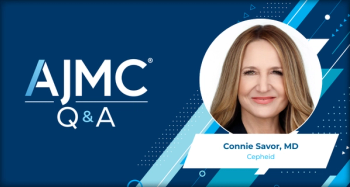
Cepheid's Connie Savor, MD, MBA, explains where its 13-pathogen respiratory panel fits in diagnostic stewardship and antibiotic decisions.
Twice-yearly depemokimab reduced exacerbations and improved quality-of-life outcomes in type 2 asthma and CRSwNP studies.
Depemokimab (Exdensur; GSK), the first ultra-long-acting biologic, significantly reduced exacerbations in patients with type 2 asthma and chronic rhinosinusitis with nasal polyps (
The efficacy of depemokimab was observed over 52 weeks in patients aged 12 years and younger, randomized 2 to 1 to receive 100 mg of the drug or a placebo subcutaneously every 26 weeks. A select cohort of patients was also invited to join a single-arm AGILE OLE study to continue treatment with depemokimab for an additional 52 weeks, where patients demonstrated maintained response to the drug.
In the phase 3 SWIFT 1 and 2 trials, there were 762 patients. Overall, there was a 69% reduction in exacerbations when compared with the placebo in the CRSwNP subgroup (Adverse Events Reported [AER]: 0.51 [depemokimab, n = 80] vs 1.61 [placebo, n = 33]) and a 51% reduction in those without CRSwNP (AER: 0.51 [depemokimab, n = 421] vs 1.03 [placebo, n = 227]).
Secondary outcomes included St. George's Respiratory Questionnaire (SGRQ) total and Asthma Control Questionnaire-5 (ACQ-5) scores. The CRSwNP subgroup showed greater improvement in both scores when compared with the overall population receiving depemokimab. The change from baseline (CFB) in SGRQ total score with patients in the depemokimab group at week 52 was −13.92 (0.76).
Beyond reducing exacerbations, the findings suggest depemokimab may offer sustained improvements in patient-reported outcomes, an important consideration for individuals living with severe type 2 asthma. Frequent exacerbations are associated with increased health care utilization, reduced quality of life, and progressive declines in respiratory function.
The greater improvements observed among patients with CRSwNP are also notable, as this population often experiences a higher symptom burden and more difficult-to-control disease. During the poster presentation, researchers noted that the consistent efficacy observed across both clinical and quality-of-life measures supports depemokimab's potential as a long-acting treatment option capable of reducing disease burden while requiring only twice-yearly dosing.
The results from the AGILE single-arm group also demonstrated reductions in exacerbations. There were 641 patients who entered the AGILE study who received 1 or more of depemokimab, 419 in the depemokimab group, and 210 in the placebo group. AER reductions were maintained over the full 2-year SWIFT/AGILE period in the depemokimab group (0.52 [0.45, 0.60]).2
The maintenance of the response in the depemokimab in the AGILE study group over the 2-year SWIFT/AGILE period (CFB at Week 104: −16.29 [0.85]).
Similarly, CFB in ACQ-5 score with depemokimab at Week 52 in SWIFT-1/-2 was −0.81 (0.05); this reduction was sustained across the 2-year period (CFB at Week 104: −0.89 [0.05]).
Overall, adverse events (AE) were reported in 86% of patients. The most common AEs were COVID-19 (25%), nasopharyngitis (23%), and upper respiratory tract infection (16%). Treatment-related AEs (TRAEs) occurred in 6% of patients. Headache (1%), injection-site reaction (< 1%), and leukopenia (< 1%) were the most commonly reported TRAEs.
Serious AEs (SAEs) occurred in 13% of patients, with asthma (3%) being the only SAE to occur in ≥ 1% of patients. No treatment-related SAEs or fatal SAEs occurred in the study.
References
1. Pavord ID, Heffler E, Lugogo NL, et al. Depemokimab demonstrates sustained long-term efficacy and consistent patient-reported outcomes over 2 years in patients with type 2 asthma and chronic rhinosinusitis with nasal polyps: an integrated analysis of the phase III SWIFT-1/-2 and the open-label extension AGILE studies. Presented at American Thoracic Society 2026 International Conference; May 17-20, 2026; Orlando, Florida. Abstract 520
2. Pavord ID, Chanez P, Zhu CQ, et al. Depemokimab demonstrates sustained long-term efficacy and consistent patient-reported outcomes over 2 years in patients with type 2 asthma: an integrated analysis of the SWIFT-1/-2 and AGILE studies. Presented at American Thoracic Society 2026 International Conference; May 17-20, 2026; Orlando, Florida. Abstract P1396
3. Bourdin A, Jackson CJ, Jarreta D, et al. Twice-yearly depemokimab is well tolerated over 2 years in patients with type 2 asthma: an integrated safety analysis of the phase III SWIFT-1/-2 and the open-label extension AGILE studies. Presented at American Thoracic Society 2026 International Conference; May 17-20, 2026; Orlando, Florida. Abstract P1391