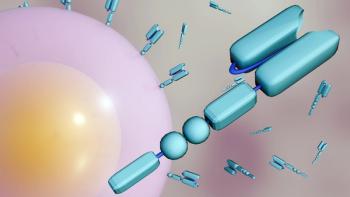
CAR T-cell therapy must be treated as a complete "vein-to-vein" episode, with community practices needing to take control of cases for a period of time.
Mitchell Blewett, PharmD, MS, of Cleveland Clinic, explains why formulary approval is only the midpoint before a new oncology drug reaches patients.
Captions were auto-generated.
Formulary approval is only the midpoint of the process that precedes a first infusion, according to Mitchell Blewett, PharmD, MS, director of oncology pharmacy at Cleveland Clinic. He spoke with The American Journal of Managed Care® at the 2026 annual
The process starts when a physician submits a formulary request. Blewett's team of oncology pharmacy specialists then builds a drug monograph covering safety, efficacy, comparative data, and cost of therapy. Supply chain staff may begin early contracting conversations with manufacturers. The
After approval, teams must then load the drug into Epic, build a Beacon treatment protocol, and create an intravenous compounding recipe. Because Cleveland Clinic uses gravimetric technology, specific gravity must be entered, and vial diameter and collar height are programmed for compounding robots. Billing, coding, staff education, and workflow design follow. Go-live typically occurs 6 to 8 weeks after the panel meeting.
Blewett cited 2 recent therapies that each cost more than $100,000 per dose. One is given in interventional radiology, with a 30-minute window between compounding and infusion. The other is stored at –80° Celsius and thawed in a 98.6° water bath for no more than 5 minutes.
Representatives from regional sites sit on the panel and follow the same timeline. Differences arise mainly when a