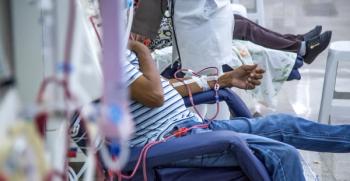
Jennifer Flythe, MD, MPH, discusses individualizing dialysis volume management and why guideline-directed therapy use lags in advanced CKD.
In-home step training for multiple sclerosis showed no improvement in ankle proprioception or muscle performance, highlighting challenges in exercise adherence.
An in-home, exergame-based step training program did not improve ankle proprioception or plantarflexor muscle performance in people with
The findings add important physiologic context to the iFIMS trial, a large, multicenter randomized controlled study that previously showed the “smart±step” intervention did not reduce fall rates in people with MS.2 Although earlier pilot data suggested step training could improve balance-related factors, the new analysis suggests those benefits may not be driven by changes in proprioception or muscle performance at the ankle.1
The nested study enrolled 66 community-dwelling adults with MS (Expanded Disability Status Scale scores 2-6), randomly assigned to either 6 months of in-home step training using the smart±step system (n = 33) or usual care (n = 33). The intervention group was encouraged to complete at least 120 minutes per week of interactive stepping “exergames” designed to challenge balance, coordination, and cognitive processing.
Investigators focused on secondary outcomes thought to underlie balance and gait, including ankle proprioception—measured by movement detection threshold and reaction time—and plantarflexor muscle performance, including isometric maximal voluntary contractions of the plantarflexors before and after fatiguing.
After 6 months, no significant differences were seen between the intervention and control groups across any proprioceptive or muscle performance outcomes. Confidence intervals for all between-group comparisons crossed zero, and time-to-recovery measures following muscle fatigue were also unchanged.
“These findings were contrary to our hypothesis,” the authors wrote, noting that step training did not improve sensory or motor contributors to balance and walking in this subgroup of participants with MS. However, the results align with the broader findings of the iFIMS trial, which included 469 participants and found no reduction in fall rates with smart±step training, the authors noted.
A borderline improvement in walking speed was observed in the intervention group in the current analysis, but the effect was small and did not persist in complier average causal effect analyses, suggesting limited clinical relevance.
The authors emphasized that the absence of physiologic improvements does not mean in-home step training lacks value. Home-based interventions are accessible, relatively low-cost, and may help people with MS maintain physical activity in an engaging format—an outcome that remains meaningful given the barriers many patients face in accessing supervised rehabilitation.
Participants in the intervention group averaged just more than 60 minutes of step training per week, well below the targeted 120 minutes, highlighting a common challenge in long-term exercise adherence. No adverse events related to the intervention were reported, supporting its safety in this population.
The analysis was limited by its nested nature, as it was not specifically designed to improve ankle proprioception or muscle performance, the authors noted. The number of participants was also low.
“Studies delivering interventions over 3 to 10 weeks suggest that the balance and gait benefits of the smart±step system may be enhanced by increasing the number of stepping directions used during training, combining training with education and behavioral therapies that encourage goal setting and self-efficacy, or performing exergames on an unstable surface to enhance the postural demands of training,” the authors wrote. “Direct benefits for muscle strength are likely to require more intense or long-lasting muscle activity.”
References
1. Djajadikarta ZJ, Dongés SC, Diong J, et al. Proprioception and muscle performance unchanged by in-home step training in multiple sclerosis: secondary outcomes analysis. PeerJ. Published online December 19, 2025. doi:10.7717/peerj.20354
2. Hoang P, Sturnieks DL, Butler A, et al. A custom-built step exergame training programme to prevent falls in people with multiple sclerosis: A multicentre randomised controlled trial. Mult Scler. 2024;30(4-5):571-584. doi:10.1177/13524585241229360