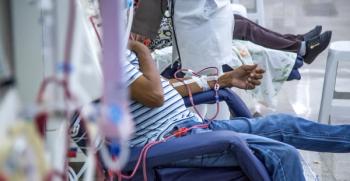
Jennifer Flythe, MD, MPH, discusses individualizing dialysis volume management and why guideline-directed therapy use lags in advanced CKD.
The study, evaluating the efficacy of the combination of efgartigimod alfa and hyaluronidase-qvfc, is the first to specifically evaluate those with ocular myasthenia gravis.
The combination of efgartigimod and hyaluronidase (Vyvgart; argenx) improved the Myasthenia Impairment Index (MGII) Patient Report Outcome (PRO) ocular scores of patients living with ocular
Efgartigimod has previously been
“I think a major advancement for the field is that this is really the first time that a new therapy has been studied in a rigorous fashion for patients with oMG,” said Jeff Guptill, MD, disease area development lead for neuromuscular programs at argenx. “Thus far, the clinical trial world has really focused on the patients with generalized MG, and unfortunately the oMG patient population has been kind of left out of the treatment advances that are kind of working through the field.”
The phase 3 ADAPT OCULUS (
Change in MGII PRO ocular score from baseline to week 4 compared with placebo was the primary end point of Part A. Participants could be seropositive or seronegative for AChR antibodies and had ocular muscle weakness determined by an MGII PRO ocular score of 6 or higher and 2 ocular items having a score of 2 or higher. All participants were on treatment for generalized MG prior to their randomization.
ADAPT OCULUS was able to meet its primary end point by showing that there was a statistically significant improvement in MGII PRO from baseline to week 4 compared with the placebo. The mean change in MGII PRO was a 4.04-point improvement in those taking efgartigimod and hyaluronidase compared with a 1.99-point improvement in those taking the placebo. Key ocular symptoms of diplopia and ptosis, which are double vision and drooping of the upper eyelids, respectively, were reduced in those taking the combination therapy.
“The improvements observed with VYVGART in the OCULUS trial offer hope to the thousands of myasthenia gravis patients with ocular involvement,” said Carolina Barnett-Tapia, MD, PhD, associate professor of medicine at the University of Toronto, in a statement.1
Overall, these results bring new options to the table for patients diagnosed with oMG to help them address their specific needs in treatment. These results will form the basis of a planned supplemental biologics license application that will attempt to extend the use of efgartigimod and hyaluronidase beyond generalized MG and into oMG.
References