
Opinion|Videos|March 6, 2024
Real-World Insights: Factor vs Emicizumab in Hemophilia A
Steven W. Pipe, MD, discusses real-world evidence comparing factor replacement to emicizumab in hemophilia A, exploring efficacy, adherence, and cost considerations.
Advertisement
Episodes in this series
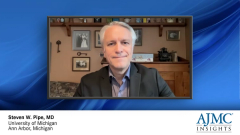
This is a video synopsis/summary of an Insights featuring Steven W. Pipe, MD.
Pipe delves into the real-world evidence surrounding factor replacement therapy and emicizumab in treating hemophilia A. With a robust clinical trial program involving hundreds of patients, the discussion extends to over 2300 individuals in real-world settings, shedding light on adherence, efficacy, and outcomes. The data suggests that patients on emicizumab prophylaxis consistently maintain low annualized bleed rates, often ranging from zero to 2, with a significant proportion achieving zero treated bleeds annually. Pipe explores switching studies, acknowledging mixed results, especially in regions with varying prophylaxis approaches. While annualized bleed rates may not always show a clear differentiator, patient preferences, quality of life measures, and activity levels strongly favor emicizumab due to its regimen ease, subcutaneous delivery, and steady-state levels. The interview also touches on cost considerations, noting that in the US, emicizumab's pricing might result in higher annualized costs compared to standard half-life agents. The comprehensive analysis underscores the importance of real-world evidence in understanding the practical implications and patient-centric benefits of these evolving hemophilia A therapies.
Video synopsis is AI-generated and reviewed by AJMC® editorial staff.
Advertisement
Related to this article

Cross-ancestry GWAS of more than 1.8 million people flags SERPINA1, SMAD3, and other bronchiectasis targets shared with COPD and chronic bronchitis.

The FDA approved bepirovirsen, the first antisense oligonucleotide for chronic hepatitis B, offering a new treatment with functional cure potential.
ALIS added to azithromycin and ethambutol raised culture conversion in new MAC lung disease, with rare resistance, in an ENCORE analysis at IDWeek 2026.

A real-world trial found 42.6% of patients with severe hand eczema cleared on oral alitretinoin.

AMCP Nexus 2026 brings managed care leaders to San Diego October 26-29 to tackle Medicare negotiation, drug pricing policy, AI, and patient access.

IDWeek 2026 posters describe a rule-based tool classifying about 1 in 5 patients with cUTI as outpatient-eligible and 5 clusters with varied LOS.

Insmed’s once-daily TPIP prodrug shows sustained lung vasodilation in PAH and PH-ILD, improving walk distance and other key measures.

An international eDelphi panel of 62 dermatologists agreed on a 2-step algorithm for tapering psoriasis biologics.
Advertisement
Advertisement
Trending on AJMC
1
Awareness Gaps Drive Narcolepsy, IH Delays: Logan Schneider, MD
2
Administrative Burden Keeps Clinicians From Bedside: Amy Morris, MD
3
International Panel Agrees on Framework for Tapering Psoriasis Biologics
4
Extension Studies in TPIP Show Promise in PAH, PH-ILD
5