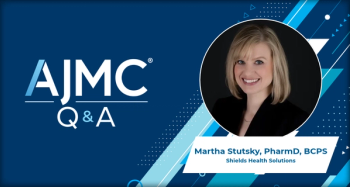
Stutsky explains why shifting therapy perceptions had more pharmacist touchpoints and longer time on therapy among patients with ATTR-CM.
Joanna Parga-Belinkie, MD, of CHOP explains how she tailors counseling to address vitamin K shot misinformation and VKDB risks.
Captions are auto-generated.
Vitamin K deficiency bleeding (VKDB) is a bleeding disorder caused by low vitamin K levels in newborns, who need the vitamin to help their blood clot. With the
Although acute complications associated with VKDB, like intracranial hemorrhage, are "pretty rare," 1 in 200 babies could have classic signs of VKDB, said Joanna Parga-Belinkie, MD, attending physician in the Division of Neonatology at Children's Hospital of Philadelphia.
"I will very much tailor the counseling to the individual family and their concerns," she said in an interview with The American Journal of Managed Care®. "The first thing I want to do is really listen and see what misinformation they've heard, because this is an intervention that's a vitamin; it's very safe."
Similar to vaccine hesitancy, many parents' fears or concerns stem from misinformation they may have seen online, Parga-Belinkie said. But addressing their concerns isn't always easy. Parga-Belinkie said she starts the conversation by asking parents what they've heard or their reasoning for not wanting the vitamin K shot.
"Some common ones I hear are that there are preservatives in the shot," she explained. "We offer a preservative-free shot in where I work in our nurseries and in our NICUs, and so that's not a concern for us."
She continued listing parents' concerns she was able to address, such as allergic reactions and the FDA boxed warning, which applies primarily to IV formulations of the medication in adults and isn't a risk she sees in newborns.
"Again, I'll try to tailor to the misinformation that they heard, but I want to know what families are thinking and feeling," Parga-Belinkie emphasized. "So I'll always encourage open dialogue and sometimes motivational interviewing."
Although the shot carries virtually no side effects or risk, she said, the complications it prevents can be severe.
"Even though I said it's really rare, I've seen those intracranial hemorrhages, and they're devastating and they're life-changing, not only for that baby, but also for that family," she said. "This is something we can prevent."
References
1. McCrear S, Loyal J. Why parents are refusing the vitamin K shot. AJMC. October 7, 2026. Accessed October 8, 2026.
2. McCrear S. Vitamin K refusals are rising: what payers need to know. AJMC. September 18, 2026. Accessed October 7, 2026.