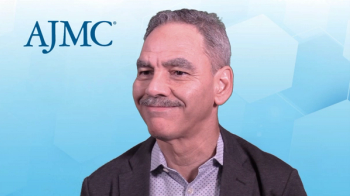
When converting a patient to a biosimilar, having clear and consistent messaging will reduce confusion and prevent patients from having a lack of trust in the process, said Paul Forsberg, PharmD, director of pharmacy, Minnesota Oncology.

When converting a patient to a biosimilar, having clear and consistent messaging will reduce confusion and prevent patients from having a lack of trust in the process, said Paul Forsberg, PharmD, director of pharmacy, Minnesota Oncology.

Being able to use minimal residual disease (MRD) negativity to make treatment decisions, such as stopping maintenance therapy, can have savings related to cost and quality of life (QOL) for patients, said Ajay Nooka, MD, MPH, FACP, associate professor, Winship Cancer Institute.

Biomarker testing should be done on all patients with an initial diagnosis of advanced nonsquamous non–small cell lung cancer, but the testing rates in the real world are lower than they should be, particularly for underserved or minority populations, said Ticiana Leal, MD, associate professor, director of the Thoracic Medical Oncology Program, Department of Hematology and Medical Oncology, Emory University School of Medicine.

While commercial payers have been engaged with the shift to biosimilars, they all have their own preferred biosimilar, which makes it challenging for practices, explained Lalan Wilfong, MD, vice president of payer relations & practice transformation at The US Oncology Network.

Everyone agrees that minimal residual disease (MRD) is the best prognostic tool for multiple myeloma, but there is disagreement on how to use the MRD results, said Ajay Nooka, MD, MPH, FACP, associate professor, Winship Cancer Institute.

While initially there was a need for education around biosimilars, now there is a need to keep an eye on the evolving biosimilar marketplace and update the formulary of biosimilar medicines, said Paul Forsberg, PharmD, director of pharmacy, Minnesota Oncology.

Minimal residual disease (MRD) testing is used to understand the depth of response, but currently the data at Emory are not used to make treatment decisions, said Ajay Nooka, MD, MPH, FACP, associate professor, Winship Cancer Institute.

The 1-year gap after the end of the Oncology Care Model (OCM) means some practices have to make hard decisions regarding cost of care or the financial health of the practice, explained Lalan Wilfong, MD, vice president of Payer Relations & Practice Transformation at The US Oncology Network.

While the Community Oncology Alliance (COA) was involved in humanitarian work in Puerto Rico after Hurricane Maria, the crisis in Ukraine caused COA to set up a special committee to jump into action, said Ted Okon, MBA, executive director, COA.

Results from DESTINY-Lung01 have shown promising progression-free survival and overall survival with ongoing research that may lead to a future FDA approval in non–small cell lung cancer (NSCLC), said Ticiana Leal, MD, associate professor, director of the Thoracic Medical Oncology Program, Department of Hematology and Medical Oncology, Emory University School of Medicine.

Despite the Hospital Transparency Rule being in effect, the majority of 340B hospitals are not reporting their prices for top services and drugs, and those that have, reported on “egregious” markups, said Ted Okon, MBA, executive director, Community Oncology Alliance.

To ensure patients will use digital health solutions, they need to be at the table when these tools are being designed, said Amila Patel, PharmD, chief clinical officer, Navigating Cancer.

The ruling by the Supreme Court on 340B reimbursements was narrow, but it sets up a future reimbursement reduction by HHS that is even greater based on survey data, said Ted Okon, MBA, executive director, Community Oncology Alliance.

There are some similarities among various value-based payment programs for cancer care, but they are not identical, said Susan Escudier, MD, FACP, vice president, value-based care and quality programs, Texas Oncology.

The involvement of pharmacy benefit managers (PBMs) in 340B is the “colliding of 2 worlds,” said Ted Okon, MBA, executive director, Community Oncology Alliance.

Telemedicine visits can make physicians more efficient, but the ability to report symptoms can add to the workload burden as staff try to figure out which symptoms need to be addressed, said Susan Escudier, MD, FACP, vice president of value-based care and quality programs, Texas Oncology.

Data presented at the American Society of Clinical Oncology annual meeting found non-White patients are less likely to receive immunotherapy for head and neck cancer, said Amila Patel, PharmD, chief clinical officer, Navigating Cancer.

Even though the Oncology Care Model (OCM) ended on June 30, 2022, there are some improvements that practices should continue implementing, said Susan Escudier, MD, FACP, vice president of value-based care and quality programs, Texas Oncology.

Navigating Cancer has found patients, including those who are elderly, are adopting applications to stay connected with their care teams, said Amila Patel, PharmD, chief clinical officer, Navigating Cancer.

As part of the investigation into pharmacy benefit managers (PBMs), the Federal Trade Commission (FTC) should delve into how PBMs are impacting and fueling drug prices and set up guardrails to protect Americans, said Ted Okon, MBA, executive director, Community Oncology Alliance.

The use of digital health solutions has been a tremendous benefit during the pandemic that should continue, said Susan Escudier, MD, FACP, vice president, value-based care and quality programs, Texas Oncology.

Previously, patients with low expression of HER2 were categorized as HER2-negative but adding the HER2-low classification creates new opportunities for patients with advanced breast cancer, explained Debra Patt, MD, PhD, MBA, executive vice president of Texas Oncology.

Digital health care has been a key initiative at Texas Oncology, because it ensure patients can receive better care at their home, explained Debra Patt, MD, PhD, MBA, executive vice president of Texas Oncology.

Although the Oncology Care Model (OCM) is ending June 30, 2022, it does not mean practices can turn back the clock and revert to how they provided care prior to the OCM, explained Debra Patt, MD, PhD, MBA, executive vice president of Texas Oncology.

Designing rational spending targets and having small sample sizes are 2 main challenges payers and partners face in the shift toward alternative payment models (APMs), said Ravi B. Parikh, MD, MPP, assistant professor of medical ethics and health policy, assistant professor of medicine, University of Pennsylvania.

After the Oncology Care Model (OCM) expires at the end of June, Tennessee Oncology will take what it learned from the model and apply it to commercial value-based care arrangements and potentially the next Medicare model, said Leah Owens, DNP, RN, executive director of care transformation at Tennessee Oncology.

Experts from The US Oncology Network discuss the future of value-based cancer care, and what practices can do as the Oncology Care Model expires.

Experts from The US Oncology Network discuss the future of value-based cancer care, and what practices can do as the Oncology Care Model expires.

Experts from The US Oncology Network discuss the future of value-based cancer care, and what practices can do as the Oncology Care Model expires.

Experts from The US Oncology Network discuss the future of value-based cancer care, and what practices can do as the Oncology Care Model expires.

259 Prospect Plains Rd, Bldg H
Cranbury, NJ 08512
© 2025 MJH Life Sciences®
All rights reserved.