

Hope Krebill of the Masonic Cancer Alliance at the University of Kansas Medical Center outlines patient navigation models that improve outcomes and reduce missed appointments.
Hope Krebill of the Masonic Cancer Alliance at the University of Kansas Medical Center outlines patient navigation models that improve outcomes and reduce missed appointments.

Advancements in breast cancer care and treatments with reproductive and urinary oncologist Lakshminarayanan Nandagopal, MD.
Hope Krebill, MSW, BSN, RN, discusses the challenges rural hospitals face in delivering therapies like CAR T and bispecifics.
From proactive recruitment to academic-community partnerships, Hope Krebill highlights ways to improve clinical trial participation.
Oranus Mohammadi, MD, outlines how antibody-drug conjugates are transforming breast cancer treatment across subtypes and discusses her approach to sequencing high-cost targeted therapies within payer and clinical practice constraints.

Matias Sanchez, MD, a hematologist-oncologist at University of Illinois Health, discussed the latest advancements in value-based multiple myeloma care, including minimal residual disease strategies and innovative targeted therapies.
Oranus Mohammadi, MD, discusses the emerging applications of circulating tumor DNA (ctDNA) in breast cancer care and emphasizes the importance of clear communication to help patients navigate uncertain or anxiety-provoking biomarker test results.

Joanne Mortimer, MD, FACP, FASCO, discusses the practical applications and limitations of circulating tumor DNA (ctDNA) testing in breast cancer, highlighting its role in guiding targeted therapy, challenges in patient communication and payer coverage, and unique barriers for male patients.
Jorge Nieva, MD, explores the challenges of translating biomarker testing into treatment decisions for non–small cell lung cancer (NSCLC), the role of repeat testing in detecting resistance mutations, and the importance of equitable access to molecular diagnostics in value-based care settings.
Jorge Nieva, MD, highlights the critical role of molecular testing in non–small cell lung cancer (NSCLC) care, while addressing barriers such as limited tissue samples, delayed turnaround times, and the need for faster, more accessible diagnostic technologies.

Yale Podnos, MD, MPH, FACS, discusses strategies to address social determinants of health in oncology, improve clinical trial enrollment for underserved communities, and leverage value-based care models to reduce financial toxicity and ensure equitable cancer care.
Daniel Virnich, MD, highlights the need for proactive social determinants of health screening, language-inclusive clinical trial practices, value-based treatment decisions, and policy reforms to improve equitable access to cancer care.
Lauren Antrim, MD, of City of Hope Cancer Center Duarte, emphasized the need for more evidence to guide optimal immunotherapy duration and sequencing in in non–small cell lung cancer (NSCLC), highlighting ongoing trials and the potential role of ctDNA in tailoring treatment strategies.
Matias Sanchez, MD, a hematologist-oncologist at University of Illinois Health, discussed strategies to deliver cutting-edge multiple myeloma care while mitigating costs.

Ravi Vij, MD, MBA, discusses how measurable residual disease (MRD) testing is shaping treatment decisions in hematology and its potential to reduce costs and toxicity.

The definition of comprehensive non-small cell lung cancer (NSCLC) testing is rapidly evolving with new biomarkers and therapies, according to Julia Rotow, MD, creating added challenges for community practices.

Cutting-edge therapies can help move the treatment landscape forward, but basic treatment and prevention, such as smoking cessation, are still valuable means of addressing non–small cell lung cancer (NSCLC).

Jonathan Thompson, MD, MS, explains how financial, insurance, and socioeconomic barriers limit equitable access to biomarker testing and advanced therapies, underscoring the need for provider advocacy and systemic support.
Ravi Vij, MD, MBA, explains how insurance-related delays in CAR T approval slow treatment initiation, increase interim therapy costs, and contribute to patient burden.
Treatment challenges that Anasuya Gunturi, MD, PhD, encounters in her work at Lowell General Hospital include language differences and confusion about scheduled appointments.
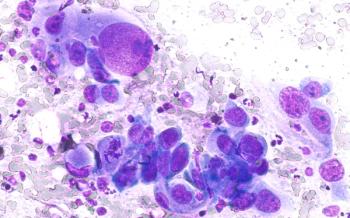
In advanced non–small cell lung cancer (NSCLC), discontinuing immunotherapy after 2 years can maintain durable responses while reducing financial and toxicity burdens, with decisions guided by residual disease testing and shared decision-making, explained Jonathan Thompson, MD, MS.
Making treatment for non–small cell lung cancer (NSCLC) accessible to a wide range of the population can help to improve outcomes from and knowledge of the condition.
Ravi Vij, MD, MBA, discusses the logistical differences between administering CAR T-cell therapy and bispecific antibodies, and how emerging CAR T technologies could affect patient access.

Jonathan Thompson, MD, MS, explains that adjuvant immunotherapy benefits patients with early-stage lung cancer with incomplete neoadjuvant response, while treatment decisions in the adjuvant setting must weigh efficacy, toxicity, and limited evidence.

Jonathan Thompson, MD, MS, highlighted that reducing delays in molecular testing and treatment initiation is critical for improving lung cancer outcomes, and that clinical trial data suggest immunotherapy duration can often be safely de-escalated in patients who achieve a complete pathologic response.
A panel held during the Institute for Value-Based Medicine event in Chicago on August 14, 2025, included discussions of access to biomarker testing and perioperative treatment in patients with non–small cell lung cancer (NSCLC).

Jonathan Thompson, MD, MS, emphasized that broader molecular testing in early-stage non–small cell lung cancer (NSCLC) is essential to guide perioperative treatment decisions, while selective retesting at progression can identify resistance mutations or new targets to optimize value-based care.

Emilie Aschenbrenner, PharmD, BCOP, outlines how Froedtert Health and the Medical College of Wisconsin use outpatient-based care models, standardized protocols, and collaborative partnerships to improve cost-effectiveness, accessibility, and patient experience.

Jonathan Thompson, MD, MS, emphasized that comprehensive biomarker testing with next-generation sequencing and PD-L1 analysis—implemented as reflex testing at biopsy—is essential to guide precision therapy in lung cancer and to address persistent disparities in timely, equitable access to care.

Clayton Irvine, PharmD, MBA, MS, discusses how pharmacists are essential to advancing payer–provider collaboration in value-based care by shaping formularies, standardizing drug reviews, leveraging real-world evidence, and leading pilot programs to optimize patient outcomes and cost-effectiveness.