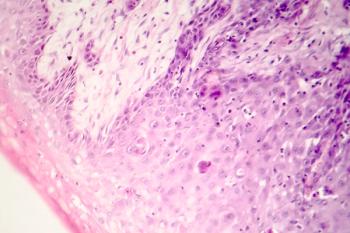
Cosibelimab received an NCCN Category 2A preferred designation for locally advanced CSCC, supported by durable responses and low immune toxicity.
Full INTerpath-001 results show the individualized mRNA therapy plus pembrolizumab reduced recurrence risk in resected stage IIB-IV melanoma.
Adding the investigational individualized neoantigen therapy intismeran autogene (intismeran; V940 or mRNA-4157) to pembrolizumab (Keytruda; Merck) reduced the risk of recurrence or death by 42% vs pembrolizumab alone in patients with completely resected stage IIB-IV melanoma, according to detailed phase 3 INTerpath-001 (NCT05933577) results.1
“The transformative INTerpath-001 results have the potential to make a foundational shift in how we treat patients with earlier-stage melanoma in the adjuvant setting,” said Professor Georgina Long, the study’s principal investigator and medical director of Melanoma Institute Australia, Chair of Melanoma Medical Oncology and Translational Research at the University of Sydney,
The data will be presented during Presidential Symposium I at the European Society for Medical Oncology (ESMO) Congress 2026 and have been accepted for publication in The New England Journal of Medicine. They follow the companies'
After a median follow-up of 24.6 months, intismeran plus pembrolizumab lowered the risk of recurrence or death (HR, 0.58; 95% CI, 0.45-0.75; P < .001) and reduced the risk of distant metastasis or death by 38% (HR, 0.62; 95% CI, 0.45-0.85; P = .002) vs pembrolizumab alone.1 The 2-year RFS rate was 82.2% with the combination vs 70.0% with pembrolizumab alone, and 2-year DMFS rates were 88.5% and 80.2%, respectively. Median RFS and DMFS were not reached in either arm, and improvements were generally consistent across prespecified subgroups.
The trial randomly assigned 1137 patients 2:1 after complete surgical resection to intismeran 1 mg every 3 weeks for up to 9 doses plus pembrolizumab 400 mg every 6 weeks for up to 9 cycles, or to placebo plus pembrolizumab, for approximately 1 year. Intismeran is produced from each patient's tumor sample and consists of synthetic mRNA coding for up to 34 neoantigens unique to that patient's cancer.
During the first 6 months, efficacy was comparable between arms for recurrence or death (HR, 0.99; 95% CI, 0.66-1.49) and distant metastasis or death (HR, 1.01; 95% CI, 0.58-1.79). After 6 months, following completion of the intismeran regimen, a prespecified sensitivity analysis showed a 58% reduction in the risk of recurrence or death (HR, 0.42; 95% CI, 0.30-0.58) and a 50% reduction in the risk of distant metastasis or death (HR, 0.50; 95% CI, 0.34-0.73).
In a modified intention-to-treat analysis that excluded participants who did not receive at least 1 dose of intismeran or placebo as planned, the reductions were 49% (HR, 0.51; 95% CI, 0.39-0.67) and 45% (HR, 0.55; 95% CI, 0.40-0.77), respectively.
Overall survival data are not yet mature, although the companies reported a favorable trend. Treatment-related adverse events (TRAEs) occurred in 95.8% of patients receiving the combination and 90.0% receiving pembrolizumab alone; grade 3-5 TRAEs occurred in 14.2% and 13.4%, respectively. The most common adverse events with the combination were pyrexia (52.2%), injection site pain (51.0%), and fatigue (38.5%). No new safety signals were observed, and the companies said they are engaging with regulatory authorities.
The data leaked online the morning before the companies released them, and the primary RFS result fell at the low end of investor expectations,
Merck and Moderna are evaluating intismeran in 9 phase 2 and phase 3 trials across multiple tumor types, including 3 ongoing phase 3 trials in non-small cell lung cancer.1
“From the beginning, we believed mRNA technology could make it possible to develop cancer treatments uniquely matched to each patient’s tumor. The INTerpath-001 results mark a defining moment for that vision and show what’s possible when we rethink how medicines are made,” said Stéphane Bancel, chief executive officer of Moderna, in a statement. “These results reinforce our conviction that mRNA has the potential to fundamentally change how we treat cancer.”
References