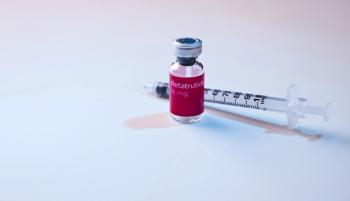
Michael Mina, MD, PhD, explains which adverse events drove VYD2311's edge vs an mRNA COVID-19 vaccine and who may benefit most.
Michael Mina, MD, PhD, explains Invivyd's accelerated approval path for VYD2311 and how it could change the timing of COVID-19 protection.
Invivyd plans to seek
In part 2 of this interview with The American Journal of Managed Care® (AJMC®), Mina explains why neutralizing titers are a reasonable surrogate for clinical benefit, giving people more control over how and when they're protected against
This interview has been edited for clarity and length.
AJMC: Invivyd plans to pursue a Biologics License Application under the Accelerated Approval Program, based on DECLARATION safety and neutralizing titer data plus LIBERTY. Clinical efficacy data would be unblinded after approval, if granted. Why is neutralizing titer a reasonable basis for approval here, and what would the post-approval confirmatory data need to show?
Mina: The neutralizing titers associated with the monoclonal antibody are a terrific surrogate for protection because neutralization by an antibody against a virus is a very direct, almost one-to-one interaction. If you can neutralize the virus, you can stop the virus from growing.
In the past, we have actually used our previous data from the same trials I just mentioned, CANOPY and EVADE, to map out what the protective threshold is and how much protection we get given a certain amount of neutralizing antibody titers in the bloodstream. So we can measure the amount of neutralization that's gained from our monoclonal antibody, and we can actually map that using what we call a Cox proportional hazards model to look at how much benefit we believe this is going to equal when it comes to reduction in PCR-confirmed COVID-19 disease. Having that map is very important to us, and it actually enables us to bridge between the surrogate endpoint here, which is the titers, and the expected clinical benefit, which is obviously what patients and providers care about.
It's not just our data, too, that gives us such strong belief in neutralization titers as a good surrogate for clinical benefit. Going back to 2020 and 2021, all the way through to today, there have been many different studies, from both monoclonal antibodies and vaccines, that have looked at how much clinical benefit is associated with an ability to neutralize the virus at different levels.
There's actually a striking correlation and similarity across studies using all different modalities of immunization that really demonstrate there is a very expected curve, where the higher your neutralizing titers are, the more clinical benefit you're going to gain in terms of a reduction of COVID-19 disease. That very simple mechanism, whereby a neutralizing antibody stops the virus from attaching to human cells and therefore stops it from growing, gives us a lot of confidence that we can take what's been shown in the past and bring it forward into our current state.
Now, as you mentioned, we won't be reading out DECLARATION results in terms of clinical benefit, because those events are still accruing, so that's going to be post-accelerated approval. We are aiming to continue the DECLARATION study and event accrual as a confirmatory study, and somewhere down the line, when those events accrue, we will be reading it out. That's something we're in discussion with the FDA about currently.
AJMC: Invivyd describes VYD2311 as a vaccine alternative. Which patients do you see it serving: people who can't or won't be vaccinated, people who want added protection alongside vaccination, or both? How might that positioning shape coverage decisions for payers?
Mina: Based on the LIBERTY data, we feel quite strongly that this monoclonal antibody will support really anyone who is looking for additional immunological protection against this virus. Nobody is fully immune to the virus, and certainly across the population, we still see people of all different age categories and health categories continue to get sick.
Now, that said, we anticipate, and we're looking to have a label that actually matches the vaccine label to a large extent—so individuals who are at high risk for severe disease. That might be individuals over the age of 65 or individuals over 12 with additional comorbidities that could put them at high risk.
In terms of how we anticipate people will use it, we actually find the LIBERTY data to be very encouraging, in that this doesn't need to be, "Do I get vaccinated, or do I use a monoclonal?" Right now, we have a situation that is very difficult. We have summer waves, and then those kind of bleed into winter waves.
As an epidemiologist, I get a lot of calls from people all the time saying, "Dr. Mina, it's August. Should I get my COVID vaccine? I hear that there's COVID hanging about." I would love to just say, "Yes, go get your COVID vaccine." But the issue is the next sentence I have to say is, "However, the winter wave is probably going to be even bigger, and if you get your COVID vaccine now, it might no longer be giving you much protection by December." So that puts the population in a very challenging position right now: When do they time a vaccine?
This is an area where I think a monoclonal antibody has a tremendous opportunity to support. We have now shown in LIBERTY that the combination of a monoclonal with a vaccine does not negatively interact with the vaccine; it actually only positively interacts in terms of reducing the unwanted symptoms of the vaccine. So it drives this question: because there's no immunological penalty, if you will, to getting a monoclonal antibody, there could be a world where people say, "Look, I want protection today in the summer, and I want it in the fall, and then when the winter comes, maybe I want protection from both a monoclonal and a vaccine, so I get both."
The existence of choice, and having one of those choices be a passive, direct immunization with a monoclonal, opens up a lot of doors for people to choose how and when they get protected, rather than the current situation, which is, "Do I take this immunological penalty today or later on in terms of getting a vaccine and eliciting a robust immune response? But if I do it now, I don't really want to do it again in a few months." That's the real choice people are currently being faced with.
We think that by providing a new modality, we'll actually see a lot of people say, "I want to get one this month and the vaccine later on," or vice versa. Or we may very well see a situation where a physician says to a patient, "Look, if you actually get both of these today, you'll be better protected over the next number of months, and you'll probably have fewer symptoms over the next few days after you get this vaccine if you get the monoclonal with it." So there are a lot of choices to be had in the future, and we're certainly contemplating how we want the label to look as we move forward with the agency.
Reference
1. McCrear S. VYD2311 shows superior safety vs mRNA COVID-19 vaccine. AJMC. October 1, 2026. Accessed October 7, 2026.