News|Articles|March 11, 2026

Data Show Epcoritamab Plus R-DHAX/C Can Be a Bridge to ASCT in R/R DLBCL

Author(s)Mary Caffrey
Fact checked by: Christina Mattina
Listen
0:00 / 0:00

Key Takeaways

  • Epcoritamab plus R-DHAX/C achieved 79% ORR and 69% CR, with median 1.4 months to response and early activity evident by the first week-6 assessment.
  • Over half of patients reached ASCT after combination therapy, and 88% of transplanted patients were in CR at transplant, supporting a bridge-to-ASCT strategy.
SHOW MORE

The results are the latest from the multiarm EPCORE-NHL-2 trial, which has studied the bispecific antibody epcoritamab in multiple uses and combinations.

During the American Society of Hematology (ASH) Annual Meeting and Exposition in December 2025, investigators presented a bounty of results from EPCORE-NHL-2 (NCT04663347), the phase 1b/2, open-label, multicenter study evaluating multiple uses and combinations of epcoritamab (Epkinly; Genmab/AbbVie).1

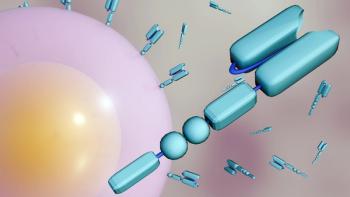
This subcutaneous CD3×CD20 bispecific antibody is FDA approved on its own to treat relapsed/refractory (R/R) diffuse large B-cell lymphoma (DLBCL) and in combination with lenalidomide and rituximab for R/R follicular lymphoma (FL).2 Results from 5 different arms of EPCORE-NHL-2 presented at ASH 2025 showed strong responses for epcoritamab in combinations across different patient groups.1 Now, data presented this week from arm 4 show epcoritamab’s potential in a different role: as a bridge to autologous stem cell transplant (ASCT).3

Published in Haematologica, the findings report on use of epcoritamab in patients with R/R DLBCL who are eligible for high-dose therapy (HDT) followed by ASCT. This regimen can be curative in patients who relapse 12 months after their initial treatment—if they have a good response to salvage chemoimmunotherapy. However, only 40% to 60% of patients achieve an overall response and only about half make it to ASCT.3

“The treatment of R/R DLBCL remains challenging, with inadequate responses to salvage chemoimmunotherapy limiting patients’ ability to receive potentially curative treatments like [ASCT],” the authors write.3

The new data from arm 4 of EPCORE-NHL-2 show that combining epcoritamab with rituximab, dexamethasone, cytarabine, and oxaliplatin/carboplatin, or R-DHAX/C, produced strong responses in HDT-ASCT–eligible patients with CD20-positive R/R DLBCL. Of note, 55% proceeded to ASCT after the regimen, with 88% of transplanted patients in complete response (CR) at the time of transplant. Another 5 patients choose to stay on epcoritamab monotherapy rather than proceeding to ASCT, and all achieved a CR.

Study Design. Patients received a 48-mg dose of subcutaneous epcoritamab weekly during three 21-day cycles alongside standard R-DHAX/C chemotherapy. Following combination treatment, epcoritamab monotherapy continued until ASCT or disease progression. To be eligible, patients had received at least 1 prior line of therapy and had measurable disease. The primary end point was investigator-assessed overall response rate (ORR) by Lugano criteria.

Twenty-nine patients were enrolled between February and September 2021. Among those enrolled, 72% had stage IV disease, 66% had primary refractory disease, 83% had progressed within 12 months of first-line therapy, and 26% had double-hit or triple-hit lymphoma. Of note, 10% previously received chimeric antigen receptor (CAR) T-cell therapy.

Results. After a median follow-up of 40.4 months, with data cutoff at January 15, 2025. Results were as follows3:

  • Epcoritamab plus R-DHAX/C produced an ORR of 79% and a CR rate of 69% across all 29 patients.
  • Median time to response was 1.4 months and median time to CR was 1.5 months, with many responses evident at the first scheduled assessment at week 6.
  • Of the 29 patients, 21 (72%) completed the planned combination treatment per protocol. Sixteen patients (55%) proceeded to ASCT, with 88% in CR at the time of transplant.
  • Of the 5 patients who opted to continue on epcoritamab instead of ASCT, 3 of 5 had sustained a CR at data cutoff, with duration of response beyond 35 months.
  • At 36 months, 70% of responders remained in response, and median progression-free survival was not reached; 76% of all patients were still alive.
  • Among patients who received ASCT, 83% remained in response; median overall survival was not reached at 36 months.
  • Eight patients stopped treatment early, primarily due to disease progression. Outcomes were poor; 7 patients died before data cutoff.

Safety data were consistent with known effects of both epcoritamab and the R-DHAX/C regimen. All 29 patients experienced at least 1 treatment-emergent adverse event (TEAE), and 97% had grade 3 or 4 events. The most common TEAEs were thrombocytopenia (90%), anemia (66%), neutropenia (59%), and nausea (52%).3

Cytokine release syndrome (CRS) occurred in 45% of patients, but all events were low grade (grade 1-2), most commonly presenting as fever, and resolved within a median of 2 days; no patient discontinued treatment due to CRS. One patient experienced grade 2 immune effector cell–associated neurotoxicity syndrome, which resolved but led to epcoritamab discontinuation. No fatal TEAEs and no clinical tumor lysis syndrome events were observed. The authors note that 44% (7 of 16) of transplanted patients required plerixafor for stem cell mobilization, but all were ultimately successfully mobilized and none failed to proceed to ASCT.3

The main limitations cited were the study’s small size and single-arm design. Still, the authors wrote that results support the possible use of bispecific antibodies and epcoritamab in particular as a key component in salvage regimens, especially when CAR T-cell therapy is not easily accessible. Besides more than half of patients proceeding to ASCT, there was long-term disease control and a manageable safety profile. Combined with efficacy outcomes that compare favorably with trials such as ZUMA-7 and TRANSFORM, they wrote, “these results support the potential benefit of adding epcoritamab to salvage therapy regimens and warrant further evaluation in larger, controlled studies.”3

References

  1. Genmab to showcase latest blood cancer treatment advancements at 2025 American Society of Hematology (ASH) Annual Meeting. News release. Genmab. November 3, 2025. Accessed March 11, 2026. https://ir.genmab.com/news-releases/news-release-details/genmab-showcase-latest-blood-cancer-treatment-advancements-2025
  2. Caffrey M. EPCORE FL-1: adding epcoritamab to R2 delivers “new benchmark” in second-line follicular lymphoma. Am J Manag Care. 2026;32(Spec. No. 1):SP30. https://www.ajmc.com/view/epcore-fl-1-adding-epcoritamab-to-r2-delivers-new-benchmark-in-second-line-follicular-lymphoma
  3. Abrisqueta P, Karimi YH, Morillo D, et al. Epcoritamab plus rituximab, dexamethasone, cytarabine, oxaliplatin/carboplatin induces deep and durable responses in transplant-eligible patients with relapsed or refractory diffuse large B-cell lymphoma: results from the EPCORE NHL-2 trial. Haematologica. Published online March 5, 2026. doi:10.3324/haematol.2025.300086