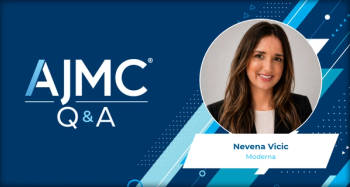
Nevena Vicic, MSc, discusses first real-world data showing mRNA-1283 protected adults 65 and older from COVID-19 hospitalization in 2025-2026.
OneOncology's Larry Bilbrey outlines network-level contracting, data security, physician review of AI output, and clear vendor lanes for AI.
Community oncology practices can reduce risk from artificial intelligence (AI) by handling contracting and data security at the network level, requiring physicians to check AI recommendations, and keeping vendors in clearly defined lanes, according to Larry Bilbrey of OneOncology.
In an interview with The American Journal of Managed Care®, Bilbrey discussed contracting and data security, the risks of overlapping vendors, and why commoditization of AI tools may be coming.
Bilbrey said contracting is a big starting point. For the OneOncology network, the goal is to put agreements such as a master services agreement and a business associate agreement in place at the network level so individual practices do not have to negotiate them. Rates can also be negotiated at the network level, where scale can save practices money.
Data security is next. Bilbrey said the network has a data warehouse and extensive security and that it controls the channels used to send data to vendors. A smaller or less mature practice may lack those protections and put patient data at risk. "We've got to make sure the data is safe," Bilbrey said, covering both patient data and proprietary data.
Bilbrey also stressed that AI is not perfect. When AI makes a recommendation, the physician needs to read it and confirm it is accurate.
"We should not be accepting AI recommendations just blindly because 98% of the time it's right, and we hope that's true, but...2% of the time, we need to make sure we catch that 2%," Bilbrey said.
Community practices do not have large electronic medical record systems such as Epic building solutions in house. Instead, Bilbrey said, practices assemble many point solutions, with one tool for scribes, another for faxes, and so on. The challenge is making those pieces work together.
Bilbrey gave an example of 3 companies that were each producing clinical summaries of the same data. That created 2 problems. The organization was paying each vendor a token cost to summarize identical information, and the chart held 3 different summaries. "If something happened and I go into discovery for a legal case, and I got 3 different summaries, and all 3 say something different, or one says something wildly different, it's going to be hard to defend," Bilbrey said.
The answer is orchestration. Vendors should not duplicate work or bleed into each other's lanes. "You have to be very clear about the lanes that they're supposed to stay in," Bilbrey said.
Bilbrey expects commoditization. Many of the smaller AI companies are likely to be acquired or to fail because foundation model developers have billions of dollars and are moving into health care. Keeping up without comparable funding will be difficult. Bilbrey predicted that the large general-purpose models, naming ChatGPT and Claude, will end up owning and commoditizing most of this market.
Until that happens, practices must manage the individual solutions in front of them. The goal, according to Bilbrey, is to ensure that they are not creating more risk and more issues than before.