
Mike Fazio, director of value-based care at Navista, Cardinal Health, discusses a trending topic at the 2025 Community Oncology Conference: optimizing oncology care with technology.
Mike Fazio, director of value-based care at Navista, Cardinal Health, discusses a trending topic at the 2025 Community Oncology Conference: optimizing oncology care with technology.

Results presented on Tuesday at the American Association for Cancer Research annual meeting include data on the combined use of tissue and liquid biopsy, as well as a framework for evaluating multicancer early detection testing.
Oncology leaders from Alliance Cancer Specialists, American Oncology Network, CHI St. Vincent, Memorial Sloan Kettering Cancer Center, and New York Cancer & Blood Specialists discussed the power of collaboration in cancer care, highlighting partnerships that enhance patient outcomes and resource sharing in community practices.

At Asembia’s AXS25 Summit, industry experts explored how pharmacy is evolving to meet rising patient expectations and navigate a shifting health care environment.
Mingyang Song, MBBS, ScD, discusses the link between ultraprocessed foods and cancer risk, emphasizing nutrition's role in prevention.
K. "Vish" Viswanath, PhD, explores the evolution of health misinformation, its sources, and the role of technology in shaping public understanding.
Evaluating the impact of the Inflation Reduction Act (IRA) will require real-time data and effective therapy metrics, explained H. John Beardsley, MBA, of CoverMyMeds; and Fauzea Hussain, MPH, of McKesson.
Raymond Osarogiagbon, MD, discusses the challenges of implementing lung cancer screening guidelines and the need for increased awareness and access.

With artificial intelligence (AI) capabilities freeing up workers and driving billions in gains, pharmacy may soon see a 75% workload drop.

Early actions by the new administration signal major changes in health policy, taxes, and pharmaceutical pricing.

Prior studies have shown that women may absorb cancer therapies differently than men, but this study focused on the fallout on patients' physical activity and quality of life.

From a meeting that celebrates basic research and being "first," a look at 3 data sets on therapies that would break new ground.
Kimlin Tam Ashing, PhD, of City of Hope National Medical Center, emphasizes the vital role of community engagement in cancer research, enhancing trust and communication between scientists and communities.
Zongertinib shows promise for treating HER2-mutant non–small cell lung cancer (NSCLC), with significant activity against brain metastases and low interstitial lung disease risk, explains John Heymach, MD, PhD.
Artificial intelligence (AI) has the potential to deliver personalized nutrition; however, there is a need for professional oversight, emphasized Julia Logan, BS.
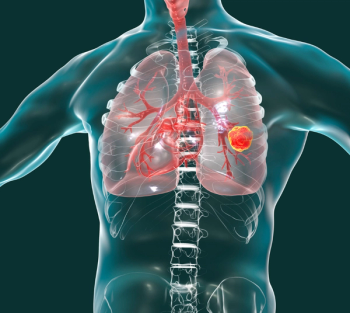
Results could give patients with HER2-mutated non–small cell lung cancer (NSCLC) an oral therapy option.
John Heymach, MD, PhD, The University of Texas MD Anderson Cancer Center, discusses the promising results of zongertinib for HER2-mutated non–small cell lung cancer, showcasing high response rates and improved patient quality of life.
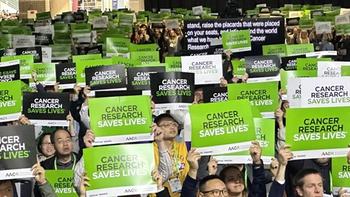
The session follows the American Association for Cancer Research's (AACR) prior call to action against executive orders that would harm the National Institutes of Health.
Julia Logan, BS, discusses the vital role of nutrition in cancer care, highlighting how artificial intelligence can enhance dietary recommendations for patients.
Luis Carvajal-Carmona, PhD, stresses the importance of global collaboration in cancer research to enhance understanding and treatment across diverse populations.
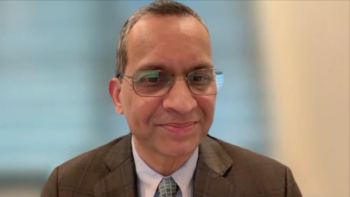
Ravindra Uppaluri, MD, PhD, lead investigator of the phase 3 KEYNOTE-689 trial (NCT03765918), highlights the need for a multidisciplinary approach to translate the study's findings into real-world care for patients with resectable head and neck cancer.

Dostarlimab effectively eliminates the need for surgery in patients with advanced mismatch repair–deficient tumors in renal cancer, enhancing quality of life.
Ravindra Uppaluri, MD, PhD, lead investigator of the phase 3 KEYNOTE-689 trial (NCT03765918), highlights the potential of pembrolizumab (Keytruda; Merck) to improve outcomes following head and neck cancer treatment.

Richard J. Nowak, MD, MS, Yale School of Medicine, explains what some early myasthenia gravis symptoms are and their impact on research efforts.
A program cochair said the agenda was designed to get attendees "out of their comfort zone." The Amercian Association for Cancer Research annual meeting runs April 25-30, with the key presentations coming Sunday through Tuesday.

Asembia's AXS25 Summit will unite more than 8000 key decision-makers to explore pharmacy innovation, artificial intelligence, policy, and patient care from April 27 to May 1 at Wynn & Encore in Las Vegas, Nevada.

Accountable care organizations (ACOs) are increasingly playing the role of data sleuths as they identify and report trends of anomalous billing in hopes of salvaging their shared savings. This mission dovetails with that of CMS, which under the new administration plans to prioritize rooting out fraud, waste, and abuse.

Program chairs Lillian L. Siu, MD, FAACR, and Matthew G. Vander Heiden, MD, PhD, highlight the cross-disciplinary approach to cancer research and innovation being taken at this year's American Association for Cancer Research (AACR) Annual Meeting.

Multidisciplinary coordination across prescribing teams, nursing, laboratory medicine, finance, and infusion centers is crucial for gene therapy delivery in Duchenne muscular dystrophy (DMD).

Sam Peasah, PhD, MBA, RPh, director of High-Value Health Care Value-Based Pharmacy Initiatives at UPMC Health Plan, discusses ways that health plans can help reduce the cost burden of medications to improve adherence.