
Commentary|Videos|June 30, 2026
Bringing Cutting-Edge MM Therapy to Every Patient: Swarup Kumar, MD
Author(s)Maggie L. Shaw, Swarup Kumar, MD
Fact checked by: Christina Mattina
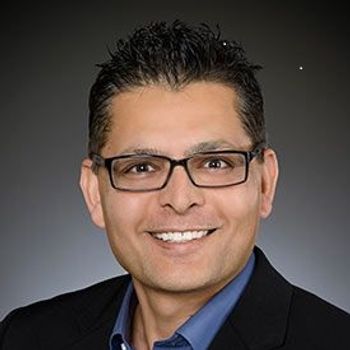
Swarup Kumar, MD, discusses how myeloma programs can bridge gaps between academic innovation and community access for bispecific antibody therapy.
Advertisement
Bringing one of oncology’s most promising new therapies—bispecific antibodies—to the patients who need it most is a daily challenge clinicians face on the front lines of
Swarup Kumar, MD, is assistant professor of medicine in the Division of Hematology and Medical Oncology at UConn Health, and a leader for UConn Health’s multiple myeloma (MM) and plasma cell
Right now, that intersection is being defined by bispecific antibodies, a class of immunotherapy that has transformed outcomes for patients living with relapsed/refractory MM and is already expanding into other cancers, including
His team has been building a model
In this conversation, he discusses sequencing bispecific antibodies for the right patients at the right moment, what it really takes to build the academic-community partnerships that make safer administration possible, and how the field needs to evolve in education, advocacy, and protocol design as these therapies
As Kumar puts it, “It’s only imperative that as the field is moving in that direction, everybody is prepared to handle the adverse events.”
Advertisement
Related to this article

These phase 3 EXCALIBER-RRMM findings build on earlier MRD-negative complete response results supporting FDA approval of the iberdomide-based regimen.
The editor in chief of Evidence-Based Oncology, who was recently named medical director of Precision Medicine for The US Oncology Network, discussed milestones met and those still to be achieved.

Cleveland roundtable panelists across 4 disease states name access, not evidence, as the shared barrier to care.
Alice Hall-Partyka, JD, a partner at Crowell & Moring explains the lawsuits challenging CMS' Medicaid rule on pediatric gender care and its legal weak points.

Siva Mohan, MD, explains how drug costs drive silent nonadherence, PA burden, and biosimilar hesitancy, and what payers can do about it.

On National Latinx AIDS Awareness Day, experts outline HIV prevention gaps in Hispanic communities and how payers can ease PrEP access.

HR 1 brings Medicaid work requirements and narrower immigrant eligibility by January 2027, and CBO projects 10 million more uninsured by 2034.

CMS ends ACA subsidies for 189,000 enrollees with duplicate Medicare, Medicaid, or CHIP coverage or listed as deceased, with a 30-day dispute window.
Advertisement
Advertisement
Trending on AJMC
1
5 Things to Know About the One Big Beautiful Bill Act
2
Coroner Reports Pennsylvania's Sixth Measles-Associated Death
3
ACA Subsidies End for 189,000 Duplicate or Deceased Enrollees
4
FAQ: How Payers Can Close HIV Prevention and PrEP Access Gaps
5