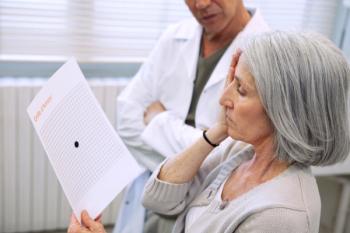
Panelists engaged in a debate regarding using complement inhibitors in geographic atrophy, gauging public sentiment with a deciding vote.

As CAR T-cell therapy expands into outpatient and community settings, Reimagine Care and The Center for Cancer and Blood Disorders are creating a monitoring infrastructure to support patients and caregivers alike.
Your husband has an aggressive form of
And now, you both wait.
It will be around day 5 or 6 before signs of cytokine release syndrome (CRS) emerge. If you’re the caregiver—which is required for a patient to receive CAR T-cell therapy—you take your spouse’s temperature while watching for signs of fatigue, chills, or gastrointestinal and cognitive symptoms that demand intervention.
The waiting happens close to the clinic, likely at home if you live nearby. Unless you’re a doctor or a nurse, which is unlikely, you wonder, “What am I looking for?” You worry—and you’re not alone.
As more patients become eligible for CAR T-cell therapy or bispecific antibodies to treat lymphoma or multiple myeloma, the unease that caregivers feel, their lack of availability, and the fears patients have about putting loved ones under stress are all reasons many opt against CAR T.1
Dan Nardi, CEO of the virtual oncology platform Reimagine Care, looked at the numbers and was determined to do something. “These CAR T therapies are amazing, truly life-changing. It's the closest thing we've come to a cure, and the fact that only 20% of patients who are eligible for these are currently getting them is still mind-boggling,”2 Nardi said in an interview with The American Journal of Managed Care® (AJMC).
In late June,
The expansion builds on an existing collaboration between the 2 organizations that has already generated a substantial track record: Reimagine Care has supported more than 6100 unique patients and logged over 220,000 interactions between its artificial intelligence (AI)-powered virtual assistant, called Remi, and clinicians in its Virtual Care Center. Engagement has remained high over time: 93% of patients use the symptom management program in the first 30 days, 80% are still active at 90 days, and 65% remain engaged at 6 months. More than 90% of patient encounters are resolved by Reimagine Care without escalation to CCBD's care team; when escalation is needed, the average response time is under 10 minutes. Across the collaboration, avoidable emergency department visits during patients' first 6 months of treatment have dropped 55%.3
Those numbers matter more, not less, once CAR T-cell therapy enters the picture. CRS can progress from mild symptoms to a medical emergency within hours,4 and the ATM program is designed to match that pace: daily virtual monitoring during the highest-risk postinfusion period, remote vital sign tracking, neurocognitive evaluations, and escalation pathways defined specifically for CRS and immune effector cell–associated neurotoxicity syndrome—all coordinated in real time with CCBD's oncology team.
“CAR T patients require an extraordinary level of coordination and vigilance, especially in the first several weeks after treatment,” Barry Russo, the longtime CEO of CCBD, said in a statement announcing the collaboration, after he worked to pass legislation that would make it easier for community practices to administer CAR T.
“This collaboration allows us to extend our reach beyond the walls of the clinic and maintain close visibility into how patients are doing between visits,” he said. “That's increasingly important as advanced therapies become more common in community oncology.”3
For Nardi, the caregiver relationship is not a peripheral concern in CAR T-cell delivery. It is one of the variables determining whether an eligible patient receives the therapy at all. In the AJMC interview, he pointed to the study about how patients decide whether to pursue CAR T—research that has stayed with him.1
The dynamic of a capable, willing patient held back by a caregiver's fear of being unable to recognize or respond to a complication at home is precisely what the ATM program is designed to address. Connected devices track blood pressure, pulse oximetry, and temperature several times a day; Remi pairs those readings with symptom check-ins delivered by text; and a nurse is available behind all of it.
“Having something like this right at your fingertips, whether it's the patient or the caregiver, is amazing—the peace of mind of getting answers within seconds really helps remove that burden,” Nardi said. He added that in patient surveys, the most common feedback Reimagine Care hears is a version of the same sentiment: “Knowing that someone has my back, knowing that someone is always there—that's probably the No. 1 biggest thing.”
The caregiver-confidence question is also an outpatient-conversion question. Until relatively recently, CAR T-cell therapy typically required an inpatient stay of several weeks, and clinical trials with the therapy were all done this way. The movement toward outpatient administration and community oncology for both CAR T and bispecific is rooted in the fact that patients avoid the infection risk that comes with a prolonged hospital admission, and patients tend to recover faster in familiar surroundings.5 But that shift only works if patients and caregivers trust that deterioration will be caught quickly, wherever they happen to be.
CCBD has treated 3 patients under the expanded CAR T program so far, a deliberately small number as the organizations refine the workflow before scaling. Nardi said Reimagine Care and CCBD ultimately intend to track how programs like ATM affect the calculus physicians already use when deciding whether a given patient can safely be managed outside the hospital; this includes those who fall into a gray zone of frailty balanced against caregiver capability.
The practice-side case for ATM rests on the same technology-plus-human model. Without connected devices and an AI assistant handling routine check-ins, Nardi said, monitoring CAR T patients this closely would require nurses to call several times a day, and this workload simply won’t scale as more practices bring cell therapy into the community.
“We're using technology and the right combination of human in the loop at the right time to connect with these patients. That's going to allow us to do this in a more scalable manner,” Nardi said. Reimagine Care also absorbs the logistics of shipping and activating monitoring devices, he said, so that clinical staff can focus on care rather than fulfillment. “They're clinicians. They want to support care. They're not in a logistics, Amazon-shipping kind of mindset.”
That framing echoed themes Nardi raised in April at the Community Oncology Alliance's Community Oncology Conference, where he described Remi as a persistent “care layer” between patients and their practice—one designed to extend clinical reach without adding to physician or nursing burden, a concern that ran throughout that conference's broader discussion of AI adoption in community oncology.6
Nardi framed the CCBD collaboration as one piece of a larger access problem. With approximately 4 in 5 eligible patients still not receiving CAR T-cell therapy, he said the reasons extend well beyond caregiver hesitation to include financial barriers, insurance coverage, and geographic access to certified treatment centers.
Reimagine Care expects several additional health systems to become active development partners in the ATM program later this year, with CCBD's program currently centered on axicabtagene ciloleucel (Yescarta; Kite/Gilead) while the practice explores adding other CAR T-cell products.
Nardi wants to see the issue of CAR T access get more attention. “For all the impact we talked about—the life-changing therapies this is having—we need to be talking about this more,” he said. “We need to be getting this to more practices, so they can bring it to more patients. That's the huge opportunity we have right now.”
References