





Clinical
Latest News
Advertisement
Latest Videos






Advertisement
More News
Although the pandemic continued to rule health care headlines, a few other stories were noteworthy in 2021 for the AJMC.com audience, including articles about a wider indication for the glucagon-like peptide-1 receptor agonist semaglutide and the heart failure drug Entresto.
Jason Starr, DO, explains circulating tumor DNA’s (ctDNA) role in oncology and its role in MRD.
Jason Starr, DO, provides an overview of molecular residual disease (MRD) in the hematological and oncological treatment landscapes.

Two posters presented at The Liver Meeting evaluated nonalcoholic fatty liver disease (NAFLD)–associated hepatocellular carcinoma (HCC) to understand the burden and identify the risk for developing HCC.
This year the United States only approved 2 biosimilars, but the FDA did grant interchangeable status to the first biosimilar.

Those with episodic migraine receiving erenumab can evaluate the treatment's efficacy after 3 months, according to a post hoc analysis.

Updated results of the MajesTEC -1 phase 1/2 study on teclistamab showed the treatment resulted in an overall response rate of 62% among heavily pretreated patients with multiple myeloma.
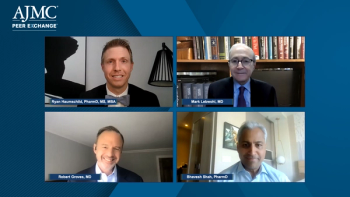
Mark Lebwohl, MD, details how he extrapolates clinical data in his decision-making when trying to treat patients with psoriasis.
Drs Groves and Lebwohl discuss payer considerations for ensuring treatment with the appropriate agent for patients with psoriasis and metabolic syndrome.
New research on semaglutide and empagliflozin appear on this year’s list of most-read diabetes articles.

Don Sin, MD, FRCP, MPH, a professor of respiratory medicine at the University of British Columbia and head of the Centre of Heart Lung Innovation, St. Paul’s Hospital, discusses future possibilities for the prevention of chronic obstructive pulmonary disease (COPD) using new biomarker discoveries and genomic technology advancements.

Robert Rifkin, MD, FACP, a medical oncologist and hematologist at Rocky Mountain Cancer Centers, describes his research on real-world treatment patterns among patients with triple-class refractory multiple myeloma.
Physicians said it is in payers’ interest to use artificial intelligence to address social determinants of health, to cover tests, and to gather data. Doing so could let them stratify who needs certain screenings and diagnostic procedures and who doesn’t, which could lead to less consumption of health care.
Duncan Allen, MHA, introduced the audience to the OneR clinical research initiative, and Jeffrey Patton, MD, discussed how the hospital transparency law has bolstered the case for the value of community oncology.

Today’s challenge, according to Microsoft's Iksha Herr, MS, is learning how to leverage artificial intelligence (AI) to process the waves of health care data and to drive insights that lead to better care delivery.
Bruce A. Feinberg, DO, of Cardinal Health Specialty Solutions, leads a panel discussion on how far randomized clinical trials have come, how they could be better, and how using real-world evidence could make research more representative of the population.

As the pandemic wore on, fewer patients with sickle cell disease who did contract COVID-19 needed to be hospitalized.

David Yeomans, PhD, associate professor of anesthesiology, perioperative, and pain medicine at Stanford University School of Medicine, discusses the potential therapeutic use of intranasal oxytocin spray for menstrual-related migraine.

Under the expanded FDA label, up to 1.8 million individuals in the United States could be eligible for sacubitril/valsartan, and up to 180,000 worsening heart failure (HF) events could be prevented or postponed.

Drawing a clearer picture of the relationship between pulmonary artery involvement (PAI) in Takayasu arteritis (TAK), researchers have published data on the clinical features of TAK with PAI.

Among the issues presented in patients with Turner syndrome, short stature is one of the most prominent, and investigators from Korea investigated the effects of a new recombinant growth hormone among this population.

Research presented at the Revolutionizing Atopic Dermatitis (RAD) Virtual Conference said dupilumab (Dupixent) is an effective and safe therapeutic option in adults, adolescents aged 6 to 11 years, and young children aged 6 months to 5 years with moderate-to-severe atopic dermatitis.

There are 2 such vaccines now in use in the United States; the Pfizer-BioNTech vaccine is fully approved for the first 2 doses for those 16 and older, and the Moderna vaccine has an emergency use authorization for those 18 and older.


In a study published in our December issue, researchers analyzed how prescribing of the newly approved heart failure drug sacubitril/valsartan diffused across the nation.
Advertisement
Advertisement
Trending on AJMC
1
TrumpRx Launch Brings Savings—and Uncertainty
2
Benefits, Tradeoffs of Medically Integrated Dispensing in Oncology Care: Katherine Tobon, PharmD, BCOP
3
PBM Reforms Signed Into Law, Reshaping Medicare Part D Drug Pricing Transparency
4
As Cencora Closes With OneOncology, Patton Says Terms Show “Trust”
5