
Oncology
Latest News
Advertisement
Latest Videos

Advertisement
More News

As the opioid epidemic persists in the United States, there are growing questions and concerns over how to manage cancer-related pain and aberrant opioid use. During a session at the 2018 American Society of Clinical Oncology Annual Meeting, Egidio Del Fabbro, MD, Virginia Commonwealth University Massey Cancer Center, discussed several management strategies that can be used to address these concerns.
Financial toxicity impacts a lot more than a patient's finances—it leads to nonadherence and poorer health outcomes. Financial navigators are increasingly being used to be proactive about addressing high healthcare costs and the resulting financial toxicity.

James Hamrick, MD, MPH, Kaiser Permanente and Flatiron Health, discusses the importance of real-world data and how it augments traditional clinical trial data.
Researchers are examining combination therapies with immunotherapy, with and without chemotherapy.
FDA has fast-tracked the Biologics License Application for cemiplimab, with a decision expected October 28, 2018.
Regeneron's Matthew Fury, MD, said the decision to move immediately to a phase 3 trial came after 2 of 3 patients in a phase 1 trial showed durable responses.
A late-breaking abstract presented on Sunday at the 2018 American Society of Clinical Oncology Annual Meeting confirmed that pembrolizumab significantly improved the primary endpoint of overall survival over platinum-based chemotherapy in treatment-naïve advanced/metastatic non–small cell lung cancer (NSCLC). The effect, the authors found, was agnostic of PD-L1 expression, meaning the monoclonal antibody was effective for tumors expressing PD-L1 at ≥50%, ≥20%, and ≥1%.
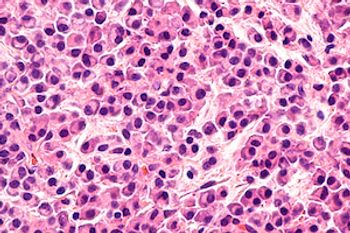
In a recent study published in the Journal of Experimental Medicine, researchers found that fingolimod (sold as Gilenya), an FDA-approved orally administered drug to treat multiple sclerosis, could reduce painful side effects of multiple myeloma treatments.
Trial Assigning IndividuaLized Options for Treatment (Rx), or TAILORx, successfully confirmed the benefit of endocrine therapy alone in patients with early-stage breast cancer who have an Oncotype DX Breast Recurrence Score of 11 to 25.
In the era of real-world data and its growing role in oncology, panelists discussed collecting and using this information in combination with clinical trials to inform evidence-based care during a session at the 2018 American Society of Clinical Oncology Annual Meeting.

Michael Thompson, MD, PhD, FASCO, Aurora Advanced Healthcare, discusses the role precision medicine currently plays in the community setting and how that role differs from that in an academic medical center.

There are multiple challenges associated with trying to pursue precision medicine, explained Victoria Villaflor, MD, associate professor of Medicine, hematology and oncology, Northwestern University.
Treatment with cetuximab, concurrent with chemoradiation (CRT), in older patients diagnosed with head and neck squamous cell carcinoma (HNSCC) has similar toxicity as CRT treatment, but overall survival is inferior. These are the results of a retrospective analysis that were presented by Dan Paul Zandberg, MD, University of Maryland, Marlene and Stewart Greenebaum Comprehensive Cancer Center, at the 2018 American Society of Clinical Oncology Annual Meeting.
A long-term follow-up of the chimeric antigen receptor T-cell treatment, axicabtagene ciloleucel (Axi-cel) in patients with B-cell lymphoma, presented at the 2018 American Society of Clinical Oncology Annual Meeting, found that a response at 3 months may be prognostic for long-term remission in those patients.

While burnout is being acknowledge much better today, it has been getting worse and there should also be focus on what burnout will look like 20 or 30 years from now, said James Grayson, administrative chief of staff at West Cancer Center.
Immune Checkpoint Inhibitors Improve Outcomes in Mismatch Repair Deficient CRC, but Can Induce irAEs
Treatment of colorectal cancer (CRC)—the third leading cause of cancer-related death in the United States—remains challenging even today. But according to leading oncologists in the field, who were speaking at a session at the 2018 American Society of Clinical Oncology Annual Meeting, screening patients diagnosed with CRC for deficient mismatch repair (dMMR) could help create a roadmap for precision treatment.
While utilization management in general is a pain point for everyone, it’s a necessary evil in the United States, where we spend 18% of our gross domestic product on healthcare, explained Debra Patt, MD, MPH, MBA, vice president, policy and strategy, Texas Oncology; medical director, analytics, McKesson Specialty Health, during a session at the 2018 American Society of Clinical Oncology Annual Meeting in Chicago, Illinois.

In order for precision oncology to be fruitful and to be effective, we need interoperability and we need to be able to share patient data, said James Lin Chen, MD, Ohio State University, and chair of ASCO CancerLinQ Oncology Informatics Task Force.
Ellen Miller Sonet, MBA, JD, chief strategy and policy officer, CancerCare, discusses the financial burden cancer patients face and how novel therapies and next-generation sequencing impact the burden.
Leading global experts believe that for immunotherapy to work in glioblastoma—which has an estimated 5-year survival rate of 33% in the United States—combination treatments are the way forward.
Every week, The American Journal of Managed Care® recaps the top managed care news of the week, and you can now listen to it on our podcast, Managed Care Cast.

The ability to create health information technology tools is happening much faster than the ability to figure out what to do with them, explained Peter Paul Yu, MD, FASCO, FACP, physician-in-chief, Hartford HealthCare Cancer Center.
At the 2018 American Society of Clinical Oncology Annual Meeting, June 1-5, Chicago, Illinois, Noopur S. Raje, MD, director, Center for Multiple Myeloma, Massachusetts General Hospital Cancer Center, presented results from the phase 1 multicenter study with a second-generation chimeric antigen receptor (CAR) T-cell therapy called bb2121.
There is going to be an increased use of next generation sequencing testing, and the challenge is going to be to figure out when and how, said Leonard B. Saltz, MD, executive director of Clinical Value and Sustainability, head of Colorectal Oncology Section, Memorial Sloan Kettering Cancer Center.

The latest version of FDA's patient-focused drug development initiative is trying to gather patient perspectives in a systematic way, but the effort faces the challenge of understanding the spectrum of those perspectives, said Mark Fleury, PhD, MS, principal of Policy Development and Emerging Science at the American Cancer Society Cancer Action Network (ACS CAN).
Advertisement
Advertisement
Trending on AJMC
1
5 Things to Know About the One Big Beautiful Bill Act
2
Coroner Reports Pennsylvania's Sixth Measles-Associated Death
3
PBM Reform and Supportive Care Needs: Nicolas Ferreyros
4
Genetic Analysis Links Insomnia Liability to Higher Inflammation Marker
5