

Debra Patt, MD, PhD, MBA, MPH, discusses how AI can streamline prior authorization and revenue cycle workflows in community oncology.
Debra Patt, MD, PhD, MBA, MPH, discusses how AI can streamline prior authorization and revenue cycle workflows in community oncology.

Most community oncology practices now administer bispecific antibodies in-office, but reimbursement gaps remain a top barrier, a survey finds.
Karen van Caulil, PhD, explained why employers evaluating cancer care weigh timely access, quality, and equity alongside cost.
Stephen "Fred" Divers, MD, discusses how COA study data push back on payer bias and support community oncology's long-term sustainability.
Stephen “Fred” Divers, MD, discusses findings showing community oncology delivers outcomes comparable with academic care for breast cancer and NSCLC.
Christine Pfaff, RPh, MBA, discusses barriers to community cellular therapy delivery and the need for new business models and payer collaboration.
Debra Patt, MD, PhD, MBA, MPH, discusses AI adoption, administrative burden, and strategies to streamline prior authorization in oncology.
Bundled payment models offer employers and community oncology practices greater cost predictability while improving patient access, Baird said.
Employers can advance patient-centered oncology care through proactive benefits, quality data, navigation, and tailored support, Amanda Green, MPH, said.

PBM practices and split benefit coverage for oral vs IV chemotherapy drive high costs; a bill would close the gap for self-funded plans.
AI tools can ease administrative burden in community oncology, but practices face adoption, security, compliance, bias, and error concerns.

AI-guided breast screening is advancing faster than coverage policy, guidelines, and imaging capacity—raising questions about who qualifies and who pays.

Designated teams, standardized SOPs, and scalable workflows are essential before a community practice's first bispecific dose.
Seven oncology leaders reflect on lasting gains in patient care, cost awareness, and collaboration, and what was lost when CMS walked away.
Community Oncology Alliance AI Playbook powers digital health practice transformation, guiding teams to choose AI partners, protect data, and expand efficient care.
Alexa Simon Meara, MD, MS, discusses breaking down silos between academic and community oncology to improve immunotherapy care and irAE management.

Community oncology practices face major infrastructure and reimbursement gaps when delivering bispecific antibodies.
Pharmacists need better support to manage emotional strain tied to patient suffering, treatment costs, and care decisions, says Karen Fancher, PharmD, BCOP.
Johnetta Blakely, MD, MS, MMHC, discusses her new role as chief medical officer of the Community Oncology Alliance during an interview that will appear in the June issue of Evidence-Based Oncology.
Diana Verrilli, MS, of Navista breaks down the regulatory, payer, and cybersecurity pressures threatening community oncology practices—and maps a path forward.
Community oncology can navigate bispecific therapy rollout with staff training, clear handoffs, and reliable reimbursement, said Lekan Ajayi, PharmD.
Community oncology grapples with the logistics of bispecifics with step-up dosing straining staff and reimbursement, said Lekan Ajayi, PharmD.

Our associate editor recaps the annual conference of the Community Oncology Alliance, which took place just before Evidence-Based Oncology went to press. Look for full coverage in our June issue.
Community pharmacists must build scalable workflows as bispecific antibodies move into earlier lines and outpatient settings, notes Brooke Peters, PharmD, BCOP, of AON.
Eileen Ehret, BS, Navista, focuses on aligning quality improvement with patient safety, engaging all stakeholders, and creating safe spaces to drive change in oncology.
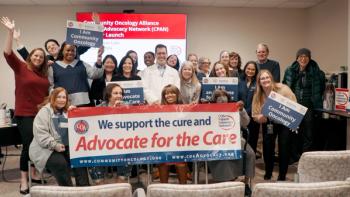
COA's Patient Advocacy Network, or CPAN, was featured in the "From Our Partners" section of the May issue of Evidence-Based Oncology.
AI drives community oncology transformation as practice leaders offer examples of what is working in community oncology to streamline calls, triage, and documentation.

As CAR T-cell therapy reaches community oncology, practice leaders discuss the challenges of payer hurdles, single case agreements, apheresis costs and whether to pursue accreditation.
Karen Fancher, PharmD, BCOP, emphasizes a pharmacist’s pivotal role in CLL care through communication, adherence strategies, and bridging patients with medical teams.