


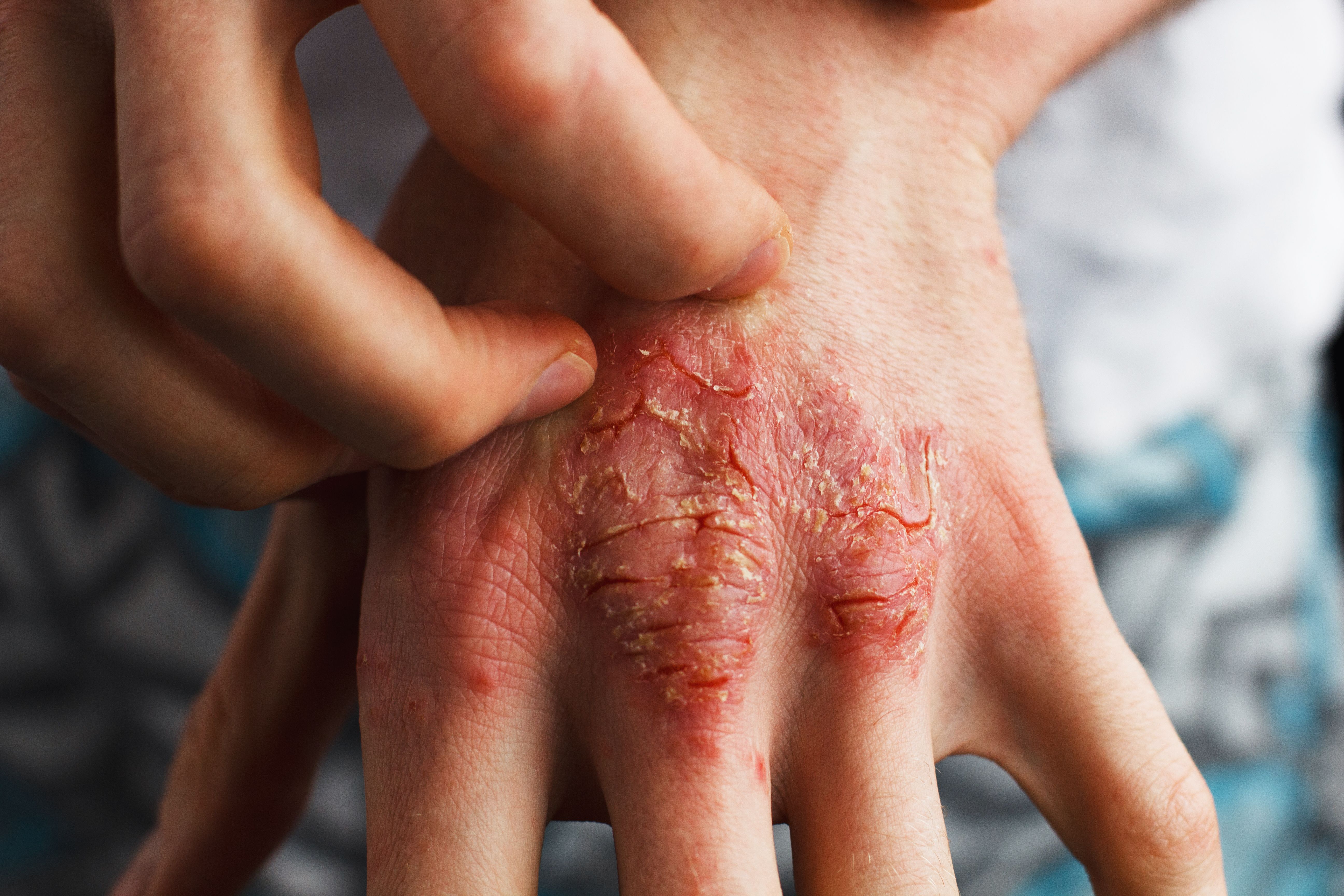

Psoriasis
Latest News
Advertisement
Latest Videos



Advertisement
More News
Posters presented at the American Academy of Dermatology Annual Meeting identified significant undertreatment of psoriasis and significant gaps in biologic medication treatment.

Laura Ferris, MD, PhD, professor of dermatology, University of Pittsburgh, reports promising response rates and a good safety profile with JNJ-2113 in patients with moderate to severe plaque psoriasis.
Posters presented at the American Academy of Dermatology Annual Meeting demonstrated both short- and long-term efficacy and safety profiles of brodalumab in patients with moderate to severe psoriasis.

Patients experienced clinically meaningful improvements in health-related quality of life (HRQoL) factors after 6 months of guselkumab, according to one study.

Study findings show that scores on the Psoriasis Area and Severity Index and the Dermatology Quality of Life Index are correlated in patients with psoriasis across several continents, but factors affecting each of these scores are different across countries.

Researchers suggest an alternative method to align drug prices with clinical benefits for patients with psoriasis.
It is important to study the safety of targeted therapies in populations at increased risk of skin cancer, according to the researchers.

Risankizumab is an effective treatment option for patients with psoriatic arthritis (PsA), according to a recent meta-analysis.

Continuous improvement was observed across the different domains of minimal disease activity criteria with guselkumab.

People of color with scalp psoriasis experienced significant improvement in scalp itch and patient-reported health-related quality-of-life outcomes.

Physicians should be vigilant when managing patients with psoriasis and concurrent metabolic disorders, according to a new study.

Response rates were greater with deucravacitinib vs placebo or apremilast at 16 weeks in patients with moderate to severe scalp psoriasis, according to one study.
A topical therapy, PF-07038124 0.01%, administered once daily was more effective than the vehicle control in patients with atopic dermatitis (AD) and plaque psoriasis, a study finds.
The top psoriasis articles included topics on new therapies for the treatment of psoriasis in adults.

In this study, 52% of adult patients achieved the treat-to-target goal of 1% BSA or less within 3 months of incorporating tapinarof cream into their biologic regimen.

Most studies involving the treatment of psoriasis do not contain any images of patients, a review finds.

Investigators explored the genetic relationship between psoriatic disease and serum lipid levels.

Mona Shahriari, MD, assistant clinical professor of dermatology at Yale University and associate director of clinical trials at Central Connecticut Dermatology, discusses how dermatologists and clinicians can work towards increasing diversity and inclusion in treating patients with skin of color with plaque psoriasis.

Two posters presented at the 2023 Fall Clinical Dermatology Conference examined patient demographics, clinical characteristics, and outcomes in patients with plaque psoriasis treated with tapinarof cream.
Bimekizumab-bkzx (Bimzelx) is the first dual interleukin 17A (IL-17A) and interleukin 17F (IL-17F) inhibitor to treat moderate-to-severe plaque psoriasis. It launches with a list price of $7200 per syringe.

Depression symptoms are often underdiagnosed and undertreated in patients with psoriasis and psoriatic arthritis, contributing to a worsened quality of life (QOL). However, a recent study found that depression, functional impairment, and worsened QOL are related.
Evaluating Work Productivity, Efficacy and Safety of Tildrakizumab in Patients With Plaque Psoriasis
Two posters presented at the 2023 Fall Clinical Dermatology Conference assessed phase 4 study findings on tildrakizumab in patients with moderate to severe plaque psoriasis.
Posters presented at the 2023 Fall Clinical Dermatology Conference evaluated how label warnings may affect new treatment initiation and real-word switching patterns for patients starting risankizumab.

Mona Shahriari, MD, assistant clinical professor of dermatology at Yale University and associate director of clinical trials at Central Connecticut Dermatology, discusses unique challenges dermatologists face when treating patients with skin of color, who may present differently from White patients.
Two posters presented at the 2023 Fall Clinical Dermatology conference identified common patterns among patients with psoriasis (PsO) and psoriatic arthritis (PsA).
Advertisement
Advertisement
Trending on AJMC
1
5 Things to Know About the One Big Beautiful Bill Act
2
Coroner Reports Pennsylvania's Sixth Measles-Associated Death
3
Medicaid Obesity GLP-1 Coverage May Offset Some Diabetes-Labeled Use
4
FAQ: How Payers Can Close HIV Prevention and PrEP Access Gaps
5