



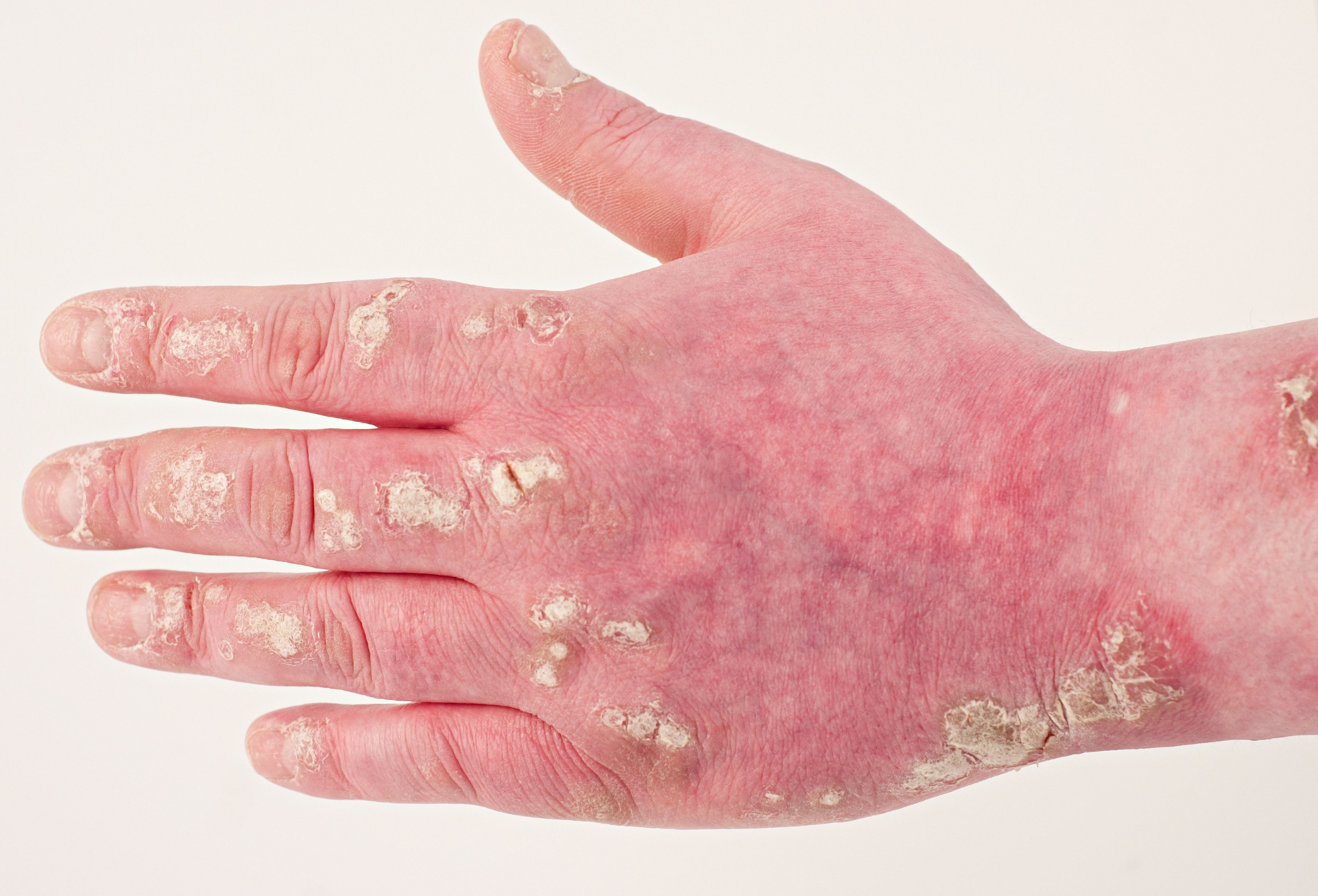

Psoriasis
Latest News
Advertisement
Latest Videos



Advertisement
More News

Because biologics are used to treat both conditions, researchers hypothesized they may be helpful to prevent psoriatic arthritis (PsA).

This analysis pooled data from the reSURFACE 1 and reSURFACE 2 trials of tildrakizumab use among patients with moderate to severe plaque psoriasis.
Minority patients with skin diseases such as psoriasis often experience racial and ethnic barriers to care, a recent review found.

Dermatologists recommended biologics at similar rates in scenarios describing Black, Hispanic, and White patients with moderate to severe psoriasis.
Polypharmacy was significantly higher in patients with psoriatic arthritis when compared with controls, according to a new study.

In this new analysis, investigators found significant agreement between in-person and remote assessments.

A panel of experts provide their final thoughts on treating psoriasis across all skin phototypes.
A panel of experts provide their final thoughts on treating psoriasis across all skin phototypes.
Maria Lopes, MD, MS, and Amy McMichael, MD, discuss how payers can incentivize patients’ use of digital health tools to monitor the success or failure of treatment.
Amy McMichael, MD, provides an overview of the Psorcast app and how it can benefit treatment adherence for patients.
Bruce Sherman, MD, FCCP, FACOEM, and Maria Lopes, MD, MS, discuss how organizations can address disparities in care for psoriasis.
Maria Lopes, MD, MS, reviews some challenges surrounding access to care, patient education, and financial burdens associated with psoriasis across skin phototypes.
Amy McMichael, MD, discusses ways to ensure patients of all races and ethnicities are experiencing the same level of quality face-to-face interactions with their providers.

The subset of patients with psoriatic arthritis had the highest odds ratio of migraine.

Findings from the survey suggest that certain symptoms of depression could help identify patients vulnerable to both worsening psoriasis symptoms and disease-related quality of life (QoL).
Maria Lopes, MD, MS, reviews how to educate providers on the risks and burdens of psoriasis and how to improve early diagnosis and treatment for all skin phototypes and ethnicities.
Bruce Sherman, MD, FCCP, FACOEM, underlines how to support patients financially to afford therapies and maintain adherence.

A study attempted to see how symptoms affect quality of life after adjusting for confounding factors.

The exact reasons for the links are not yet clear, although some evidence suggests inflammation plays a role.
Amy McMichael, MD, and Maria Lopes, MD, MS, review the major differences in quality of life, the impact on patients, and the costs and burdens associated with absenteeism or presentism.
Amy McMichael, MD, explores why psoriasis can substantially affect quality of life more severely in some ethnicities more than others.
Bruce Sherman, MD, FCCP, FACOEM, explores how to improve treatment for psoriasis and education surrounding diagnosing psoriasis for all skin phototypes.
Amy McMichael, MD, and Maria Lopes, MD, MS, review factors to evaluate when starting treatment and how to educate patients on the possible adverse events from that treatment.

After a delayed lag period, air pollution from a wildfire was associated with modestly increased rates of clinic visits for psoriasis among adults starting 5 weeks after the fire and peaking at 8 to 9 weeks after the fire.

Female patients and people younger than 18 years were particularly sensitive to pollution levels, this study found.
Advertisement
Advertisement
Trending on AJMC
1
5 Things to Know About the One Big Beautiful Bill Act
2
Coroner Reports Pennsylvania's Sixth Measles-Associated Death
3
Medicaid Obesity GLP-1 Coverage May Offset Some Diabetes-Labeled Use
4
FAQ: How Payers Can Close HIV Prevention and PrEP Access Gaps
5