
A payer discusses medical exceptions processes and triggers for a class review for drugs in women’s health, along with wraparound programs for uterine fibroids and endometriosis.
A payer discusses medical exceptions processes and triggers for a class review for drugs in women’s health, along with wraparound programs for uterine fibroids and endometriosis.
A medical professional explains the many facets of the prior authorizations process for drugs in women’s health.
Ryan Haumschild, PharmD, MBA, MS, provides background on the Affordable Care Act (ACA) within the scope of women’s health, including specific mandates on contraceptives.
Dr Slipczuk concludes our discussion by detailing healthcare disparities commonly seen within ASCVD treatment.
A cardiology expert considers the future of lipid management within health systems and ways they can improve engagement from all parties.
Dr Slipczuk explores quality metrics, elaborating on ways to improve and align them with the latest cardiology treatment guidelines and payer considerations.
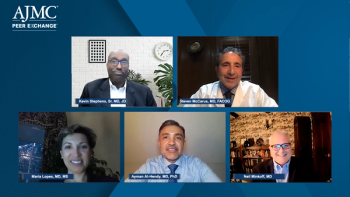
Key opinion leaders share their perspectives on utilization management strategies in treatment of women’s health.
The panel deliberates appropriate surgical intervention in women with uterine fibroids or endometriosis.
Dr Slipczuk offers strategies for sharing information and guiding appropriate ASCVD treatment both within and outside closed health systems.
Leandro N. Slipczuk, MD, PhD, details his organization’s effort to support uptake of PCSK9 inhibitors in the inpatient setting.
Payer decision-makers discuss defining value among agents for unintended pregnancy, uterine fibroids, and endometriosis.
A panel of experts discuss treatment selection among contraceptive agents and evolving treatment strategies for uterine fibroids and endometriosis.
Dr Leandro N. Slipczuk highlights the importance of cardiovascular treatment guidelines when deciding on patient care for those with ASCVD.
Three cardiovascular experts discuss the future of lipid management for patients with high-risk ASCVD.
Dr Ayman Al-Hendy discusses the diagnosis of uterine fibroids and endometriosis along with treatment goals.
Dr Steven McCarus discusses the journey of a patient with endometriosis through the health care system.
Drs Brinton and Slipczuk go into detail regarding an ideal multidisciplinary team for ASCVD treatment.
Drs Riddock and Slipczuk define “optimal care” for ASCVD from a system-level perspective with the use of quality metrics.
Payer considerations regarding unintended pregnancy is discussed by Maria Lopes, MD, MS, and Kevin Stephens Sr., MD, JD.
Ayman Al-Hendy, MD, PhD identifies risk factors for development of US and endometriosis.
Drs Steven Levine, Patricia Ares-Romero, Samuel Nordberg, Martin Rosenzweig, and Carrie Jardine share insight on the future treatment landscape for TRD.
Dr Martin Rosenzweig discusses the importance of data collection to improve patient care in TRD as well as alternative payment models.
Dr Eliot Brinton elaborates on unmet needs in lipid management and how they can be remedied.
Ian Riddock, MD, and Leandro N. Slipczuk, MD, PhD, discuss the importance of LDL-C management as part of the discharge plan for patients, as well as ensuring continuity of care from the inpatient to outpatient setting.
Kevin Stephens, Sr. MD, JD examines key drivers of healthcare utilization for women of childbearing years.
Steven McCarus, MD FACOG highlights the shift away from surgical treatment toward medical therapy in UF and endometriosis.
Drs Martin Rosenzweig and Samuel Nordberg share perspectives for integrated policymaking in behavioral health, as well as payer and provider collaboration for TRD.
Carrie Jardine leads a discussion on varying prior authorization policies for alternative therapies for TRD along with implications to patients.
Our panel concludes with their plans to incorporate RWE into MM management in the future.
Dr Baljević discusses unmet needs that are typically seen in the management of MM.