Now Playing
Debra Patt and Tara Graff open this Insights series by examining why CAR T-cell therapy access remains geographically concentrated, drawing parallels to earlier waves of specialized cancer treatment adoption.
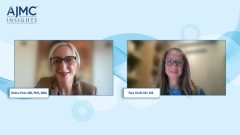
Welcome back to another AJMC Insights series. In "CAR-T Therapy: Unmet Needs and Geographic Gaps," moderator Debra Patt, MD, PhD, MBA is joined by Tara Graff, DO, MS to open the series on CAR T-cell therapy access.
Dr. Patt opens the program by introducing herself as President of the Community Oncology Alliance and Executive Vice President of Policy and Strategy for Texas Oncology, part of the U.S. Oncology Network. She welcomes Dr. Graff, a medical oncologist specializing in lymphoma at Mission Cancer and Blood in Des Moines, Iowa, who also serves as Executive Director of Cellular Therapy at the Exigent Research Network. Dr. Patt outlines the discussion ahead: unmet needs in CAR T access and administration, the delivery ecosystem across FACT and non-FACT accredited sites, and new real-world data from ASCO 2026 comparing outcomes between the two. Reflecting on 20 years in oncology, she describes CAR T-cell and T-cell engaging therapies as transformative, but likens their uneven availability to a Ferrari without a highway to drive on.
Dr. Graff explains that CAR T has changed the treatment landscape for large B-cell lymphoma, moving the therapy into earlier lines of care. She argues availability remains the central problem. She practices in Des Moines but also covers a rural clinic 90 minutes away, and many patients cannot reach an authorized treatment center at all. A four-hour drive, lost income, lack of transportation, or caregiving duties at home can each block access on their own. When a community site lacks FACT accreditation, patients must travel or forgo treatment entirely, and many ultimately choose not to pursue it.
Dr. Patt adds that CAR T access today is concentrated in major-city hubs, often within large academic programs, though that landscape is shifting. She notes that no site south of San Antonio, Texas, currently offers CAR-T. She compares this moment to the early adoption of Taxol and Rituxan, when specialized administration requirements gradually gave way to broader community use through a hub-and-spoke delivery model that could bring care closer to patients over time.
The next episode in this series, "Reimbursement as a Barrier to CAR T-Cell Access," has Dr. Graff tracing those geographic barriers down to the reimbursement realities that keep community practices from closing the gap.